



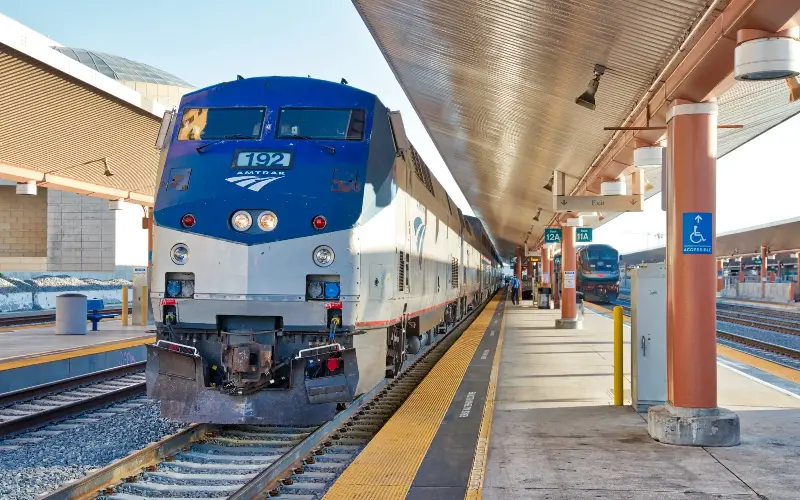
“We’re riding the rails!” yelled the woman to my left as we rolled out of Chicago’s Union Station, the living embodiment of the joy we all feel when a train gets underway. Her enthusiasm was infectious; I was half tempted to add a “yee-haw”, but managed to stop myself.
The journey I’d embarked on was certainly an epic one – from Chicago to Los Angeles along the legendary Route 66, which this year turns 100. Except that instead of driving a Chevrolet, I was travelling by train.
The rail track does not follow the exact path of the road, but it is close enough. And, as I soon found, there are many points of connection – both geographically and emotionally – on the road or, indeed, on the railroad.
Whether by car or train, to travel from the Great Lakes of the American Midwest to the Pacific shores of California – a distance of more than 2,000 miles across three time zones and eight states – is a considerable feat, and one many are undertaking in this celebratory centenary year. By the time I reached the signs signalling the start of the route in Chicago, I’d already bumped into a gang of bikers on Harley-Davidsons planning to drive all the way.
I almost envied them – but I’d committed to the rail option, where the strain of multiple days of driving (along a road that is far from its prime, and adjacent highways frequently clogged with traffic) would be replaced by leisurely contemplation, passing scenes of stunning beauty, and convivial conversation in the dining car with a rich cast of ever-changing characters. That, at least, was the idea.
There is a sleeper train which, over the course of some 45 hours (including two nights on board), does the route from Chicago to LA directly – the evocatively named Southwest Chief.
But in keeping with the spirit of the drive, I wanted to break the journey with stops along the way – and to tap into some of the Route 66 folklore that seems to lose none of its allure as it echoes down the decades.
The first of these was St Louis – not a stop for the Southwest Chief, but an important staging post for the 66 – the city of Miles Davis and the Blues, of the meeting of the mighty Mississippi and Missouri rivers and, crucially, the city hailed as the Gateway to the West, a fact symbolised by the vast arch which dominates its skyline.
It was not a particularly scenic first leg, but there was a great atmosphere on board that made the passage of five hours feel hardly any time at all. Older passengers chatted amiably about trips past – and those to come; the lady so enthused at departure beamed at the cohort of students she was escorting to the Illinois state capital, Springfield, who – instead of sitting glued to their smartphones – were talking and laughing and loving the novelty of travel by train. Two young women in the neighbouring car recalled adventures they’d shared in Spain and tucked into a picnic of cheeses, hummus and grapes they’d brought for the ride.
America’s publicly owned Amtrak trains often get a bad rap, but even in Coach class (Economy), the seats are comfortable and the legroom generous. It was a very good start.
The next day I headed north to Kansas City to connect with the California-bound Southwest Chief. This journey – a total of just over six hours – was scenically more impressive, involving long spells looking out at lush green woodland as we crossed Missouri. It was less crowded, calmer and more conducive to quiet contemplation.
I had eight hours to wait for my connection in Kansas City and ended up spending nearly all of it in the station itself – a wonderful Beaux-Arts edifice that recalls the age when the railroad ruled supreme in America. With its stupendous grand hall, vast chandeliers and a six-foot-wide clock, the station is an absolute gem; one of the best I’ve ever seen. The Pierpont’s bar and steakhouse made for an excellent place to sip Bourbon-infused Old Fashioned cocktails, eat Sirloin and chips – and wait for a train.
“Wakey, wakey; it’s egg and bacey!”
Amtrak staff like to inject a little humour into their messages – a welcome diversion on the longest of my journeys, the 23-hour ride from Kansas City to Flagstaff, Arizona. It had been a wakeful night (whisper it softly, but all that rocking and hooting and chug-a-chugging is not generally conducive to a lot of sleep) and, opening the curtains in my cosy but compact “Roomette”, I watched in awe as a red streak lit up the sky. We were now in the scrublands of southern Kansas heading for Colorado, and it was beginning to feel a great deal more like the Wild West.
After breakfast (meals in the dining car are included for Sleeper cabin passengers), I headed to the observation car and sat drinking black coffee with Bob from North Dakota, who had only ever left the United States once – to visit Winnipeg in Canada. And all the while, past the window streaked ever more dramatic scenery until, at last, the snow-clad Rocky Mountain peaks hoved into view. The hum of conversation filled the car as passengers delighted in new acquaintances; a lady quietly knitted a scarf; another kept her eyes peeled for elk; while a small cluster from the Amish community – with their unadorned dress and Shenandoah (“chin-curtain”) beards – made me wonder for a moment what century we were in.
Slowly, the train climbed more than 7,500ft to the Raton Pass, close to the Sangre de Cristo Mountains, before making a brief stop at Albuquerque, New Mexico’s largest city, with its beautiful adobe buildings and its own stretch of the original Route 66 (and, again, there were a couple of bikers).
At last, we reached the town of Flagstaff – another key staging post along Route 66 and now full of neon-lit stores and 1950s-style diners, still doing a roaring trade. Here I disembarked and took a short drive to Williams, another town on the 66 and the starting point for the Grand Canyon Railway, a short (cowboy-themed) ride on another train that connects to that most gorgeous of geological wonders.
I spent a night in Williams, then decamped to a hotel on the canyon’s South Rim, taking in one of the greatest natural sights in the world and pinching myself as, with the sun slowly setting, those famous rock faces assumed ever more fabulous hues of red.
But once again I had a train to catch – the following evening’s 20.15pm departure from Flagstaff to Los Angeles and the conclusion of my voyage. It was dark by the time we set off, and I was pleased to retreat to the familiar comforts of my Roomette, drifting off – more easily this time – then waking just before dawn, glancing out of the window and realising with delight that we were now in California and, for a glorious few minutes, travelling right alongside the original Route 66.
The final stations came and went in a blur – Barstow, San Bernardino, Fullerton – glowing under a rising sun, until at last we rolled to a thundering stop at LA’s Union Station (another humdinger). But my journey wasn’t over yet: I jumped on the metro to Santa Monica, strolled to its famous pier, and stood proudly beneath its great towering sign: “Santa Monica 66,” it read “End of the Trail”.
It was a fitting end to an epic few days. I may have travelled from Chicago to LA by train instead of Cadillac – but I still got my kicks on Route 66.
Essential
Adrian Bridge was a guest of Railbookers, which offers a 14-night Route 66 by Rail package from £1,709pp, including stays in Chicago, St Louis, Albuquerque, Los Angeles and the Grand Canyon. The package cover travel by Amtrak train (Coach class), including two nights on board, and the Grand Canyon Railway and selected excursions. Upgrades to Roomette/Bedroom class possible as are variations of the itinerary, including the possibility to combine travel by train with driving a scenic part of Route 66 (from £1,829pp).