




An Artemis II Moon astronaut feared the crew would never come home after straying too far from Earth.
Commander Reid Wiseman said that the mission had intended to travel 219,667 nautical miles from the surface – the farthest distance ever achieved by humans – before slingshotting around the Moon, and heading home.
But just when the odometer should have shown the distance starting to decrease, it began to increase, taking the astronauts further than expected, and leading to fears that a grave miscalculation meant they could no longer return to Earth.
Mr Wiseman, 50, said at the Starmus Festival in Tenerife that the scariest part was as they went around the far side of the Moon.
“Mission control in Houston had told us our maximum distance, the furthest we were supposed to be from Earth, was 219,667.
“I was watching this number, and I saw it hit 219,667, and I thought, ‘great, this is the farthest we will be from Earth, and the next number I will see will be 219,666, we’ll be going home’, but about three minutes later, I saw 219,668. It went up. I was like, ‘huh, that’s weird’.
“And then about three minutes later, it goes to 219,669, and that was the moment that I felt real fear because I thought we had just gone too far. We’re never going to come home, and so I was very scared.”
Mr Wiseman said he had an agonising three-minute wait staring at the odometer before the distance finally began to drop, at which point the crew let out a cheer.
“I knew there was a good chance we might make it,” he added.
The Artemis II mission was the first crewed flight to travel to the Moon since Apollo 17 in 1972, launching from Kennedy Space Centre in Florida on April 1 and taking six days to reach lunar orbit, before returning to Earth.
Alongside Mr Wiseman, the crew included Victor Glover, 50, the pilot, who became the first black person to fly to the Moon, Christina Koch, 47, the first woman, and Col Jeremy Hansen, 50, the first Canadian.
For the first time, the mission was live-streamed by Nasa, allowing the public to travel along with the crew virtually and turning the astronauts into international heroes.
On Saturday, the crew was presented with Stephen Hawking medals for science communication at the Starmus Festival, which was founded by Sir Brian May, who holds a doctorate in astrophysics.
‘Feeling of Earthsickness’
Speaking to The Telegraph, Mr Wiseman said being so far away from the planet gave him “Earthsickness” and said the journey had a profound impact.
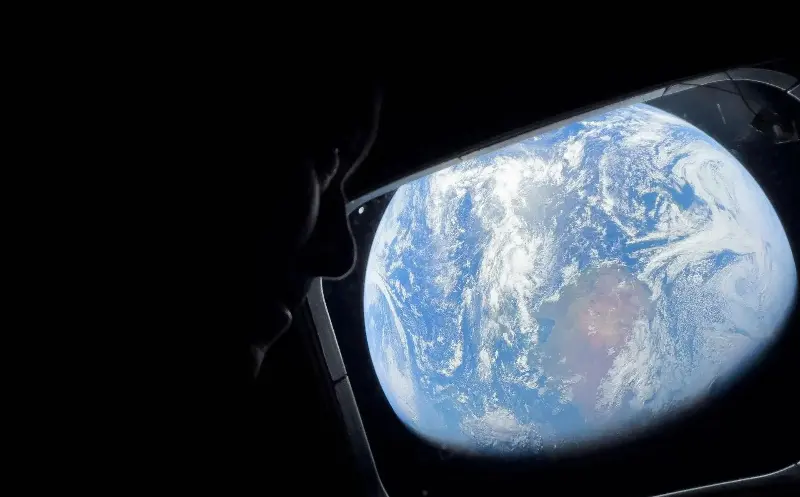
“You’re looking at an Earth that is so tiny it can fit underneath your thumb, and around it is total blackness, it’s just complete, infinite black space, and that little tiny dot down there is our home.
“And the feeling I mostly had was, I want to see my kids again, I want to be reunited with my friends, I want to sit on green grass and eat fresh salad, and just experience life on that planet again. It was overwhelming. Instead of homesickness, it was Earthsickness.”
He added: “On this mission, I will tell you, I saw things that we ran out of human language to be able to explain.
“After we landed on the USS Martha (which picked up the crew after re-entry), I asked to speak to the chaplain, because I thought on this whole ship, no one can connect with us, but he might have a chance.
“And he walked in, and I just started bawling in his arms and there was just nothing I could even say to him, the English language does not have the words for what we experienced, and he understood.”
Mr Hansen said that two days before the flight, the crew had discussed what would happen if they did not make it home.
“Like, if Reid’s number had just kept growing and we knew we weren’t coming home, but we were going to be alive for a while, how do you sit comfortably, not knowing what the future is going to be?” he said.
“And by launch the crew was at peace, not because we’re brave, it’s not bravado, it’s because we had an acceptance of whatever came, we would do the best, or our time would end.”
He added that the scariest moment of the mission for him had been re-entry, when the Orion capsule entered the atmosphere travelling 6,835 mph.
“We started to feel the G forces pushing us into our seats, kind of like someone sitting on your chest,” he said.
“And then we saw this magic light show out the window with the red plasma building, and then it turned into this bright green and blue, like somebody was welding outside the capsule.”
He said: “It was so bright, I put my visor down to protect my eyes. As we came through into the thicker parts of the atmosphere and the drogue parachutes came out and then they released, and we fell for about five seconds. We’re just falling, like a Tower of Terror ride at an amusement park.
“Then the three mains (parachutes) opened up, and that was the most beautiful feeling and sight, and we grabbed each other’s hands in celebration because that was the first time in 10 days that we were like ‘we’re really going to survive this thing’.”