



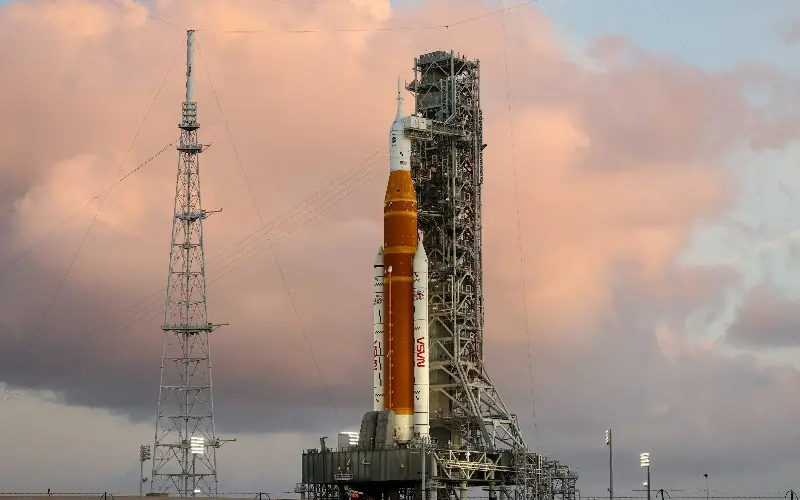
Nasa’s mission to the Moon could end up being scuppered by the Sun, after a powerful solar flare triggered radio blackouts this week.
The eruption, which flung dangerous protons into space, came from a group of sunspots that are moving further into Earth’s view, and could cause more problems in the coming days.
Solar flares release intense electromagnetic radiation and high-energy radioactive particles which can fry electronic equipment, damage satellites, disrupt radio communications, and endanger astronauts.
Nasa is hoping to launch four astronauts to lunar orbit at 6:24pm (EDT) or 11:24pm UK time on Wednesday on a 10 day mission which will return humans to the Moon for the first time since 1972.
At a briefing on Tuesday afternoon – the day before launch – Nasa said that there was a 55 per cent chance of a low-level flare in the next 48 hours, and 10 per cent chance of a dangerous X-class flare – the most intense kind, which can lead to long-lasting radiation storms.
Mark Burger, launch weather officer at the 45th Weather Squadron of Cape Canaveral’s Space Force Station, said: “Solar forecasting makes terrestrial forecasting look easy, the Sun is an entity that almost has a mind of its own.
“The Sun has become a little bit more active here over the last day and we had a solar flare erupt, but there was minimal impact for us, as most of the energy was not Earthward facing.
“But should there be additional ones that will be something that we will have to monitor.
“Right now, where that sunspot group is, it’s still kind of out on the limb. If we were to get another flare from that group, as it rotates towards the center of the solar disk, that would be something that would predispose us to getting a little bit more of that energy.
“But as far as whether or not that’s actually enough to trigger a constraint (reason to not launch) that’s still a pretty high bar.”
Nasa is concerned because the damaging particles from solar storms can arrive quickly. The initial surge in x-rays after a solar flare hits Earth around eight minutes after an eruption, while the more damaging protons begin to arrive some minutes or hours after that.
The situation is being monitored by the National Oceanic and Atmospheric Administration (NOAA).
Even if the launch is successful, solar storms can be dangerous for astronauts. The Artemis II crew have been warned to evacuate to the central storage bays of their crew module to help lower their radiation exposure in the event of an eruption.
Emily Nelson, chief flight director, said: “One of our test objectives is actually to set up the radiation shelter, so we’ll be doing that anyway, even without a radiation event.
“Basically, we’ve got a section of the spacecraft that we would set up for the crew to stay in that area until we gave them the all clear that the radiation event had passed.”
Nasa started the official Artemis II countdown on Monday night at 4:44pm EDT (9:44pm UK time) and has already begun powering up the Orion capsule, where the astronauts will live on their 10 day mission to the Moon and back.
Fuelling of the giant SLS rocket will start at 7:45pm EDT (12:45pm UK time) and there is just a two hour launch window in which the mission can lift-off.
Mr Burger said that the weather was looking promising for a launch on Wednesday, with just 20 per cent chance of problems such as rain, wind or lightning which would prevent lift-off.
However if the launch gets pushed to later in the week, then the chances of bad weather increase. On Thursday, the chance of a problematic weather issue which could prevent launch rises to 40 per cent.
“Backup launch is less favourable for weather,” he said. “It isn’t a huge drop off but we’ll have to monitor those feisty cumulus clouds, and breezes.
“But it looks pretty good for Wednesday. Even if we have showers around, we have a two hour launch window. We should be able to shoot the gap between those showers, and none of these look particularly vigorous.
“We’re still maintaining a 20 per cent chance of a no-go condition during the launch window. So the optimistic side of me says that means 80 per cent chance of a go.”