


KANSAS CITY, Mo. — When Kansas City in June 2022 was named a 2026 FIFA World Cup host city, the unprecedented opportunity to flex on a global scale was ample cause for celebration.
With KC2026 officials and dignitaries from around the region gathered at “No Other Pub” overlooking the KC Live! Block in the Power & Light District, the announcement evoked tears, hugs and something like a sonic boom in the room.
Over the course of the next few years, though, the mind-boggling development also unleashed skepticism and even downright cynicism in some circles.
And that was just locally … to say nothing of those who’d never been here or, say, even heard of Kansas City.
Especially as the stakes multiplied when Kansas City and Arrowhead Stadium were awarded six matches, including a quarterfinal, and the region was endowed with four base camps. Among those staying here were Argentina, England and the Netherlands, three of the world’s most high-profile soccer nations and teams.
Really, that was a staggering proposition — and challenge — overlaid on the smallest of 16 host cities across three countries.
While FIFA provided guidance and KC2026 immediately established a foundation, there was no precise local blueprint for something of such scope and scale.
So the very region was in the embryonic phase of what loomed as an inflection point in its future:
Can Kansas City handle something of this proportion? Will it be ready? Will the community care enough?
Distinguish itself as hundreds of thousands of visitors descended and millions around the planet watched events here, and the perception of Kansas City figured to be enhanced geometrically and likely cascade into further significant opportunities.
Stumble or otherwise disappoint? The World Cup here wouldn’t just be seen as a boondoggle or miscalculation but as a disillusioning statement about the capability of the region.
Not to mention a major impediment to future major endeavors here — both in terms of local enthusiasm and outside opinions.
If you participated or paid heed in any way, you know the rest:
The World Cup here was an incredible, indelible moment in time for Kansas City on umpteen levels, a notion that will be reaffirmed on Tuesday when KC2026 releases its Community Impact Report fusing all sorts of data points into a narrative.
Turns out they loved us, they really loved us, we loved it … and it was a singular achievement that will always stand on its own.
The rare sort of thing we’ll always have and that no one can ever take away from Kansas City — which on top of everything else was the No. 1 U.S. television market for the World Cup.
But you knew that already. The report, though, speaks to that but also something more and different.
The World Cup’s actual legacy remains to be written as an ongoing work in progress.
If it’s not exactly what have you done for us lately, well …
“The key is how we turn the moment into a movement,” KC2026 CEO Pam Kramer told The Star last week. “We did that event, and it was great. And now we go forward.”
Or as the report puts it: “Its lasting value will be determined by what we do next.”
Maybe the testimony will be through winning a bid to host the 2031 FIFA Women’s World Cup host, upcoming men’s and women’s Rugby World Cups or the NCAA Final Four as one of seven finalists from 2032-2036. Or maybe it’s in entirely different realms.
Whatever the case, the mindset here ought to have undergone a paradigm shift.
To ... what can’t we do?
Not because of mere hope but out of earned belief.
No numbers can do justice to how the World Cup made you feel, whether at any of the matches at Arrowhead or the phenomenon of how Algeria was treated at its base camp in Lawrence or the joyous, jaw-dropping spectacle of the Grand Avenue “Oranje Fanwalk” — with an estimated 36,000 participants punctuated by thousands along the route simply melding into the parade as it passed.
In the personal journal she kept for weeks, Kramer that day wrote eloquently to the meaning of the scene.
“There is a shift that has happened,” wrote Kramer in an except featured on the first page of the report. “People are now focused on holding on to the moment, being part of the moment, not missing the moment. There is pride and joy and grace and gratitude. There is a collective exhale that comes with being able to believe in ourselves.”
But beyond the anecdotal and the intangible, there’s a baseline story in the numbers — some of which previously have been released and many of which need more context than there’s space to delve into here but that still help form a tapestry.
Per Visit KC, for starters, the area welcomed some 680,000 visitors.
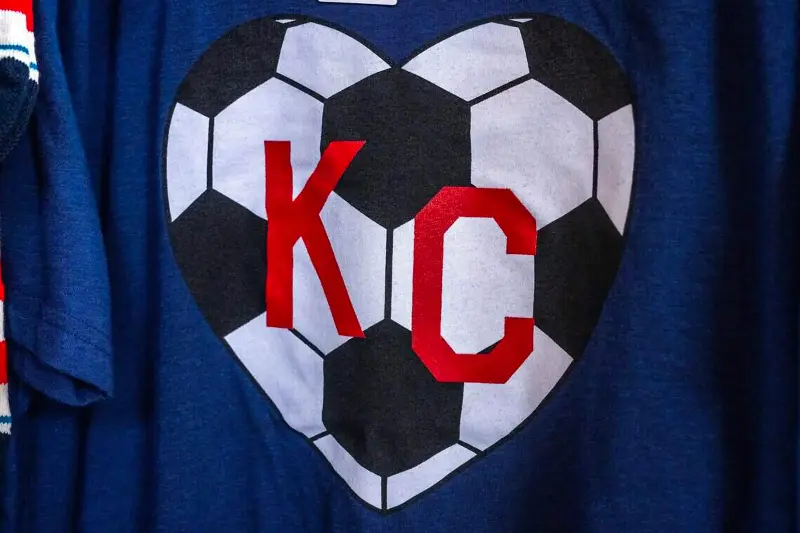
More than 400,000 attended the FIFA Fan Festival on the grounds of the National WWI Museum & Memorial — where they were greeted with the now-iconic 65-foot KC Heart Gateway that harkens to the city’s self-image as the Heart of America.
The transportation system, ConnectKC26, was integrated into existing public transportation to deliver more than 330,000 passenger journeys.
The Safety, Security and Regional Coordination element of the plan formed a joint operations center made up of 80 public safety agencies that coordinated 8,000 miles of police escorts across a sprawling bi-state area of varying jurisdictions. In one setting, it brought together authorities in transportation, public safety, emergency management, healthcare, weather and other operational aspects.
A good measure of the World Cup’s success here also was made possible by 3,400 volunteers, selected out of more than 16,000 applicants, who invested some 80,000 hours in the cause.
Per the report, the attention added up to 155 million social media impressions and what it estimated was $2.4 billion of advertising value equivalency in terms of global online editorial coverage of and set here.
All of that, though, should feel not like a culmination but a commencement of the future — one emboldened by how it unfurled and the new template made from scratch.
Some of that is highlighted in a section of the report on “Lessons Learned.”
It stresses such points as public-private partnerships being crucial and that “Economic Opportunity Is Not Evenly Distributed” — something Kramer noted was communicated upfront but that could be more directly stated in the future.
The way forward also will be paved by literal mega-event playbooks on everything from a “Local Area Transportation Mobility Plan” to elaborate schemes for “Safety and Security,” a “Human Rights Action Plan,” a “Volunteer Playbook,” a “Community Engagement Playbook,” an “Airport Signage & Dressing Plan” and for such possibilities as KC House.
That’s where international guests, ambassadors and business leaders were invited to discussions and events showcasing Kansas City. Thus far, it’s led to what the report cited as 23 international trade missions and engagements, 39 global site selection consultants and influencers engaged and four new corporate expansion projects in the Kansas City Area Development Council’s pipeline.
Maybe the most significant conclusion of all this, though, is one that’s been obvious but elusive:
None of this works as it did without hinging on bi-state cooperation, whether in terms of safety and security, logistics, facilities or hospitality.
If Kansas City’s self-proclaimed identity as the Soccer Capital of America was perhaps seen as fanciful before, it met the moment across the borders ... including through Sporting KC and the Kansas City Current’s state-of-the art training facilities and the welcoming ways that so defined those weeks across the metro area.
And much more that poises us for further such pursuits.
Especially, Kramer said, if we “start operating the way that people experience us, including the people who live here, which is as a region. Nobody stops at the state line and changes their behavior. So, let’s start harnessing the resources and leveraging those together.”
Build off that, and Kramer believes Kansas City can begin to use sports much the same way Nashville uses music: as part of its very brand and DNA.
With a jump start from now behind us but that won’t be fully realized if it stops there.
“I think the more time passes, the more people go back into their separate corners,” Kramer said. “And for us, part of the message we’re trying to relay is don’t do that.
“Let’s stay together. Let’s make sure we keep operating together, and that we together tell the world what a special place the region is.”
All the more so, she added, “when you can go forward having removed a lot of that skepticism.”