


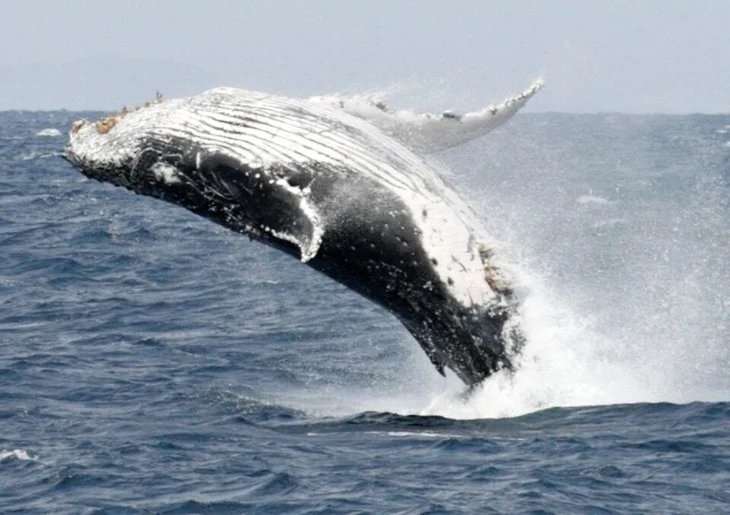
A humpback whale off the coast of Japan - Photo: REUTERS
According to IFLScience , monitoring weight is an important indicator for assessing the health of animals in zoos and conservation centers. However, not all species can remain stable on the scales.
For example, at the Pacific Aquarium (USA), staff trained a giant Pacific octopus named Glinda using positive behavior reinforcement techniques.
When it was time for her health check, Glinda was helped into a basket, then placed on a scale for a very short time before being returned to her tank.
This method allows experts to monitor the animal's weight without causing stress or affecting its health.
Glinda the octopus was weighed in a very short time - Source: AQUARIUM OF THE PACIFIC/FACEBOOK
With giraffes, the challenge lies in their height and body size.
Wellington Zoo (New Zealand) has built a special training area with a metal frame fitted with force sensors at the base. After acclimatization, the giraffes will walk into the area on their own to be weighed periodically.
This method helps veterinarians detect early signs of nutritional abnormalities or diseases in deer.
For small birds in the wild, weighing them is even more difficult because they can fly away at any time. Ornithologists often place the bird in a small plastic box or an old film roll container and then place the entire box on an electronic scale.
After the data is recorded, the bird will be immediately released back into its natural habitat.
The biggest challenge probably lies with whales – the largest animals that have ever existed on Earth.
Since they couldn't weigh the animals, the researchers used drones to take pictures from multiple angles.
Based on hundreds of images, the software will create a 3D model, calculating the length, width, body circumference, and volume of the animal. Combined with data on body tissue density, scientists can estimate the mass of each individual quite accurately.
Not only animals, but celestial bodies in the universe are also "weighed" in indirect ways.
For planets, astronomers calculate mass by observing the gravitational force acting on their satellites or orbiting objects. For supermassive black holes at the center of galaxies, mass is inferred from the speed of the stars and gas clouds under the influence of the extremely strong gravitational field.