


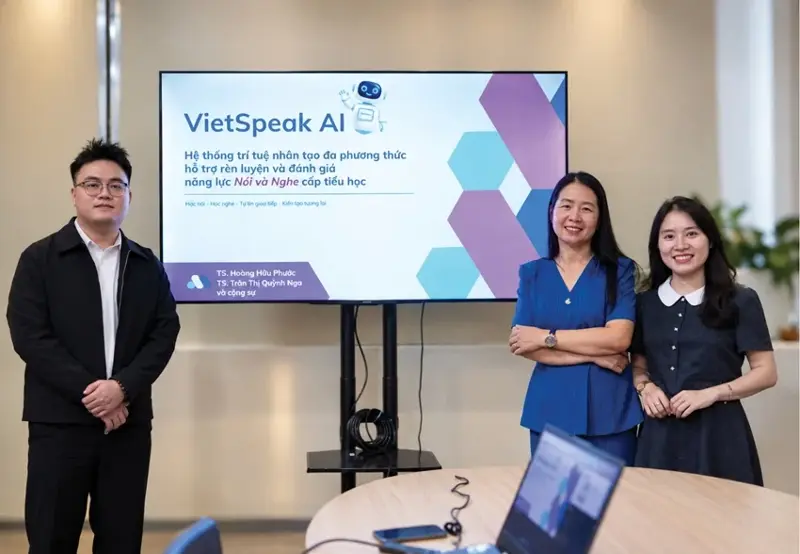
 Dr. Tran Thi Quynh Nga, co-leader of the research project (standing in the middle), Department of Primary Education , Hue University of Education, along with her colleagues.
From classroom practices to AI solutions
Speaking and listening are crucial skills in the Vietnamese language curriculum at the primary school level. To assess students' communication abilities, teachers must not only consider the content but also monitor their expression, speaking speed, volume, gestures, and attitude. However, with large class sizes and limited lesson time, providing individualized guidance and feedback to each student presents significant challenges.
Based on this reality, a research team including Dr. Hoang Huu Phuoc, Dr. Tran Thi Quynh Nga (Department of Primary Education, Hue University of Education) and their colleagues developed VietSpeak AI from January 2023 to June 2026. The system digitizes two groups of tasks, 15 types of tasks, and 45 sets of evaluation criteria (rubrics), closely following the 2018 General Education Program, serving activities such as storytelling, presentation, and interaction.
Instead of simply recording results after each presentation, VietSpeak AI aims to organize a systematic practice and evaluation process, helping teachers track progress while providing opportunities for students to practice repeatedly and proactively overcome limitations.
Dr. Hoang Huu Phuoc stated: “The highlight of VietSpeak AI is its ability to combine multiple AI technologies to analyze speech from both linguistic and non-verbal perspectives. From practice videos , the system uses speech recognition technology to convert speech into text; analyzes audio signals to determine speed, volume, and pauses; and applies natural language processing, big language modeling, and computer vision to examine content, thought patterns, gestures, and gaze.”
The data is compiled and compared against criteria appropriate to each task type to generate feedback suggestions and areas for improvement. Thanks to a multimodal approach, evaluation is not based solely on spoken words but also considers various factors influencing communication effectiveness. The system also does not automatically assume regional dialect differences are pronunciation errors, but rather focuses on clarity and conveyability.
With VietSpeak AI, the operational process includes steps from task setup, video reception and analysis, to result aggregation, teacher approval, student feedback, and practice history recording. According to Dr. Tran Thi Quynh Nga: “The overarching principle of this project is ‘AI suggests – teacher decides. ’ Artificial intelligence only plays a supporting role in analysis, aggregation, and providing evidence. The teacher is the one who checks, adjusts, and approves the results before using them in student instruction.”
Effectiveness from practical application to scalability.
Ms. Nguyen Thi Tam Chi, a teacher at Ly Thuong Kiet Primary School in Hue City, said: “Having directly experienced and used the VietSpeak AI application, I feel that it helps teachers reduce the pressure of assessment and improve the quality of feedback for each student. With a class of 35 students, listening to and commenting on each student's speaking and reading in a lesson is not easy. This application helps me save time and closely monitor the progress of each student. Parents can also record videos of their children's reading and pronunciation in Vietnamese, then upload them to the application to receive feedback and work with teachers to guide their children in practicing at home. Thanks to this, the cooperation between families and schools is closer, contributing to improving students' speaking, listening, and Vietnamese language skills.”
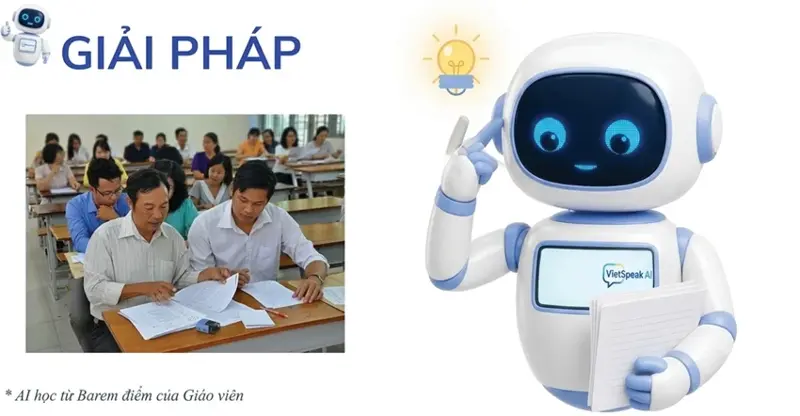 VietSpeak AI supports teachers by providing them with more specific guidance, while also giving each student more opportunities to practice, receive feedback, and improve.
According to data provided by the research team, VietSpeak AI has been used or tested with over 12,000 students, including over 1,000 ethnic minority students, and 1,042 teachers in 267 schools across 34 provinces and cities. Through comparison of over 3,500 videos with a panel of experts, the system achieved an overall similarity rate of 92.7%. The average processing time decreased from 6 minutes to 1.5 minutes per video; the number of responses per staff increased at least fivefold.
Initial results show the system's potential to help teachers reduce their assessment workload while expanding practice opportunities for students. The system has an interface and functionality similar to an app, usable on smartphones, tablets, and personal computers, and does not require specialized equipment; its modular structure also facilitates content customization according to grade level and teaching requirements.
However, for widespread and sustainable implementation, the solution needs to be accompanied by measures to protect students' personal data, especially images and audio recorded during practice. In addition, continued quality control of assessments, review of model inaccuracies, and guidance for teachers on using the tool for its intended purpose are necessary.
Winning first prize at the 16th Hue City Technical Innovation Competition in 2026 in the field of Education, VietSpeak AI demonstrates a direction for applying artificial intelligence to meet the practical needs of schools.