


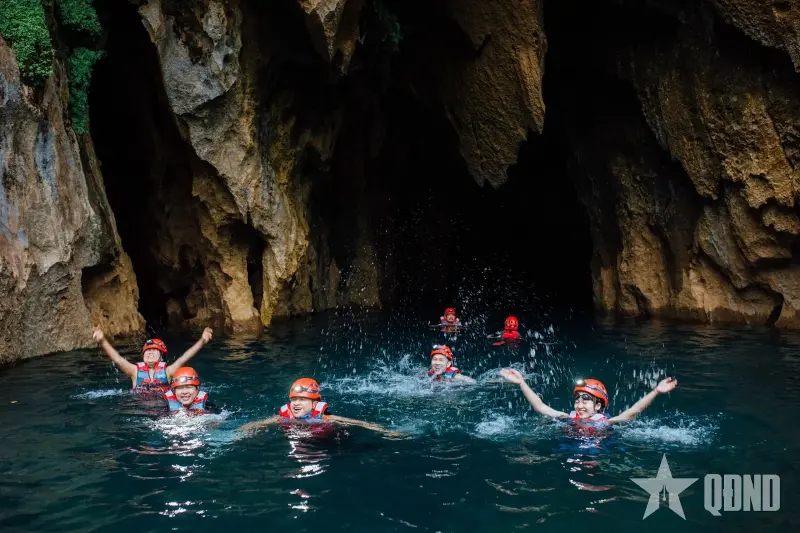
Trekking through the forest in search of a clear stream.
To reach Cave E, visitors must hike through the natural forests of the Survival Valley. The route isn't very long, but it features a variety of terrain, from dirt paths and rocky outcrops to small streams and dense forests. Therefore, right from the starting point, members of the group are instructed on the use of equipment, given guidance on navigation skills, and informed about safety regulations.
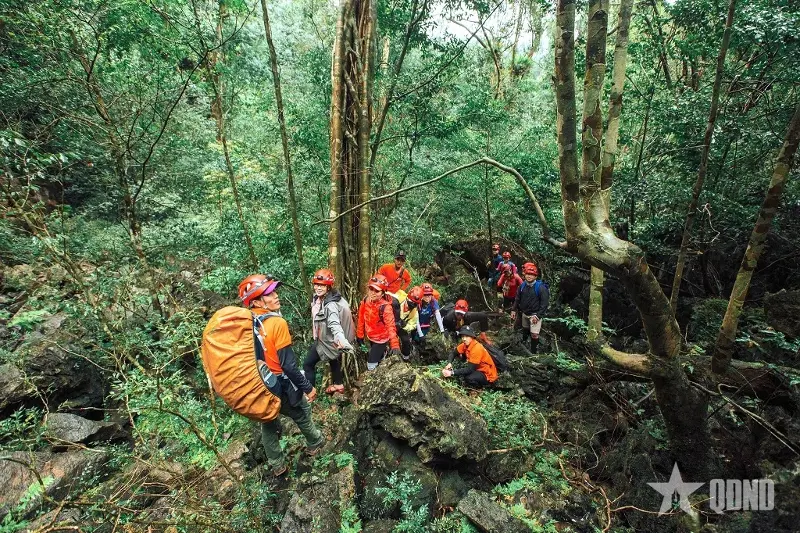 Tourists hike through the natural forests of the Survival Valley.
After a trek through the forest, the entrance to Cave E gradually emerges beneath the limestone cliffs. The first impression is a wide, clear blue lake, nestled peacefully amidst the forest. On clear days, visitors can see the rock slabs at the bottom near the cave entrance.
Cave E, also known as the Water Palace Cave, is part of the Survival Valley exploration tour . It is an active water cave with an underground stream flowing through it. Visitors can swim or use stand-up paddleboards to venture deeper into the cave under the guidance and assistance of safety personnel.
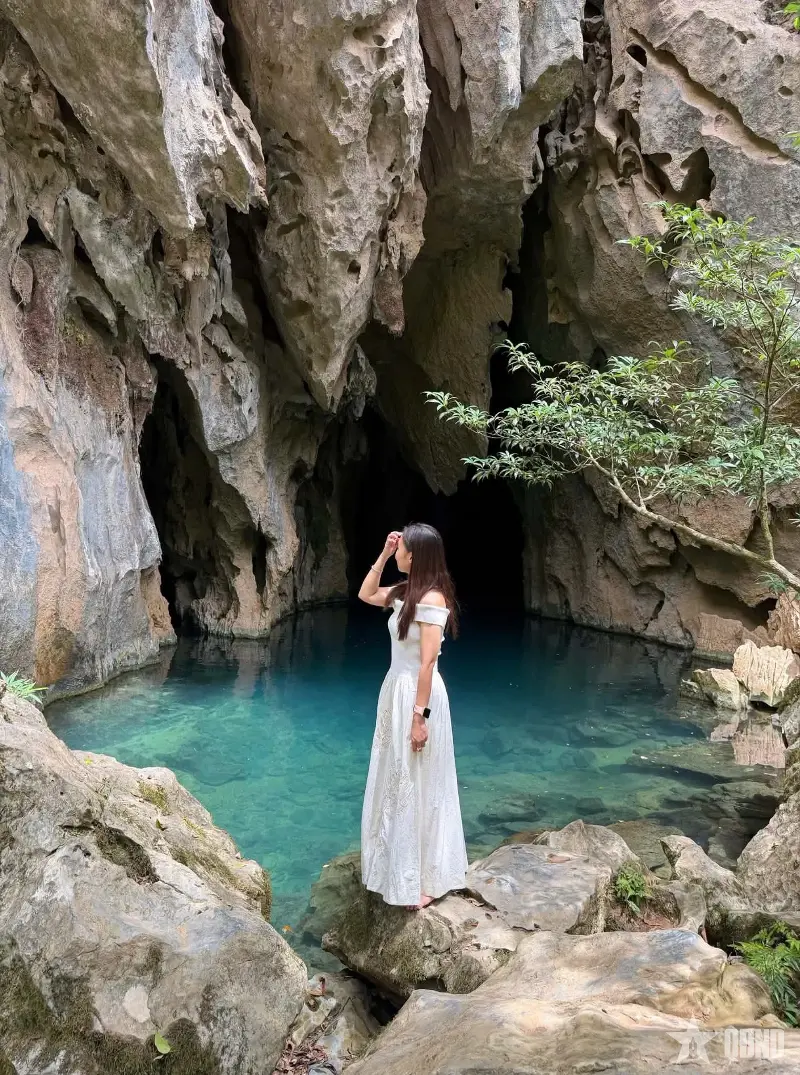
Tourists taking photos at Cave E (Phong Nha-Ke Bang National Park).
For her first time participating in the adventure, Ms. Nguyen Minh Ha, a tourist from Hanoi , said that what impressed her most was not only the color of the water but also the feeling of paddling a stand-up paddleboard in a space almost completely isolated from the outside world. “When I first stood on the stand-up paddleboard, I was quite worried because I had never paddled in a cave before. After being instructed on how to maintain balance and control the board, I gradually became more confident. The deeper we went, the less natural light there was, with only the light from my helmet reflecting on the water. The space was very quiet; every sound of the paddle hitting the water echoed clearly. This was a completely different experience from other cave tourism destinations I had visited,” Ms. Nguyen Minh Ha shared.
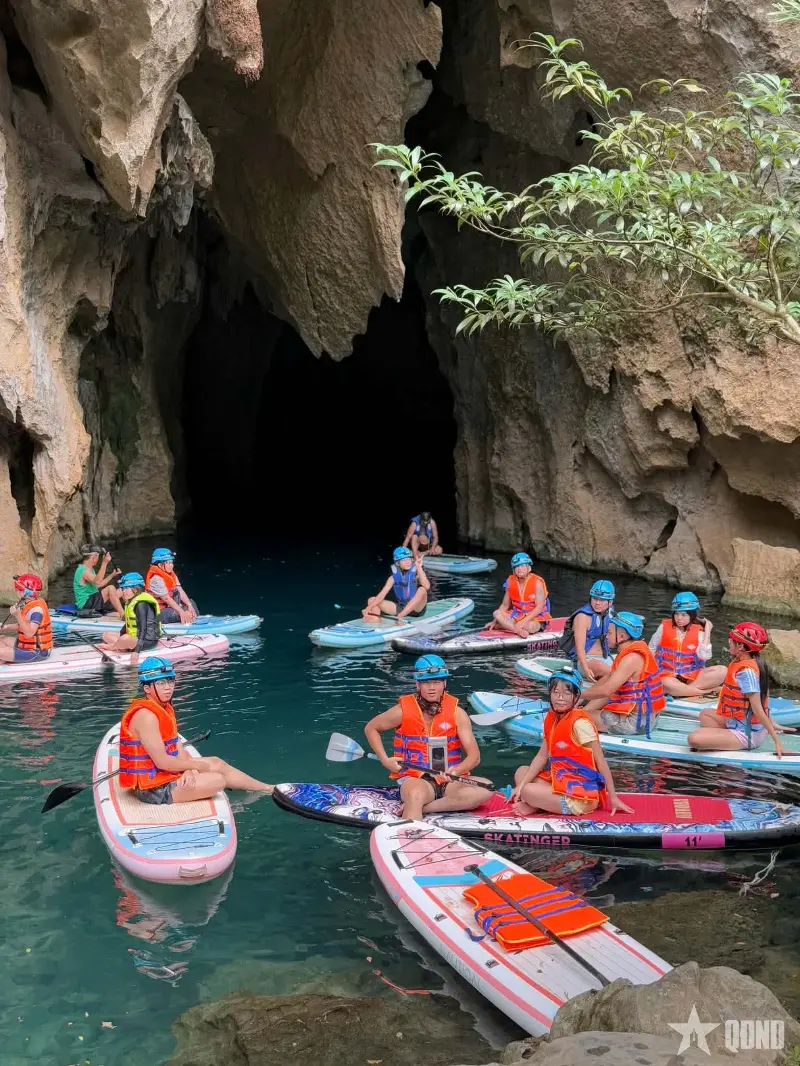 Experience paddleboarding.
As we ventured deeper inside, the temperature gradually decreased, and the air became cooler and more humid. Flashlights illuminated the layers of rock, geological cracks, and stalactites and stalagmites of various shapes. At certain locations on the cave ceiling and walls, visitors were shown fossil remains embedded in the limestone layers formed hundreds of millions of years ago.
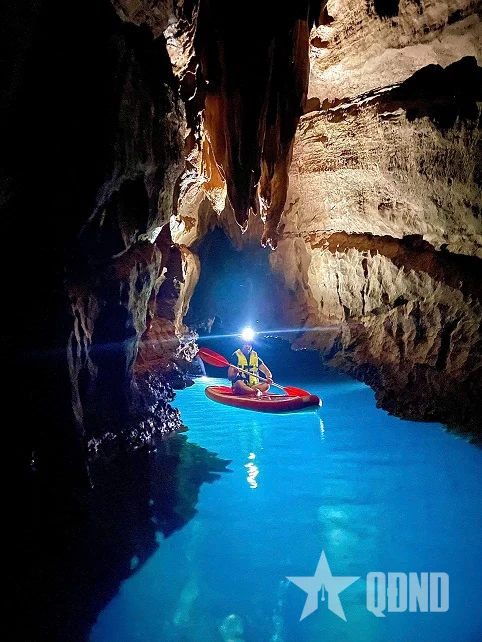 Paddling a SUP inside Cave E.
Under the lights, the clear blue water reflects off the rock arches, creating a shimmering space. Therefore, Cave E is often likened to a "crystal palace" hidden amidst the Phong Nha-Ke Bang mountains.
Experiences linked to conservation
Tour guide Do Quang Anh from Moc Nam Investment Joint Stock Company (Moc Nam Adventure) said: “The special feature of Cave E is the combination of trekking in the forest and exploring the water cave. However, this is not a mass tourist attraction; visitors must strictly follow the instructions of the tour leader. Before entering the water, we check life jackets, helmets, flashlights, and instruct guests on how to use the stand-up paddleboards. The distance to the cave is adjusted according to the weather, water level, and the physical condition of each group. When heavy rain occurs, the water level rises, or conditions are not safe, the activity will be shortened or temporarily suspended.”
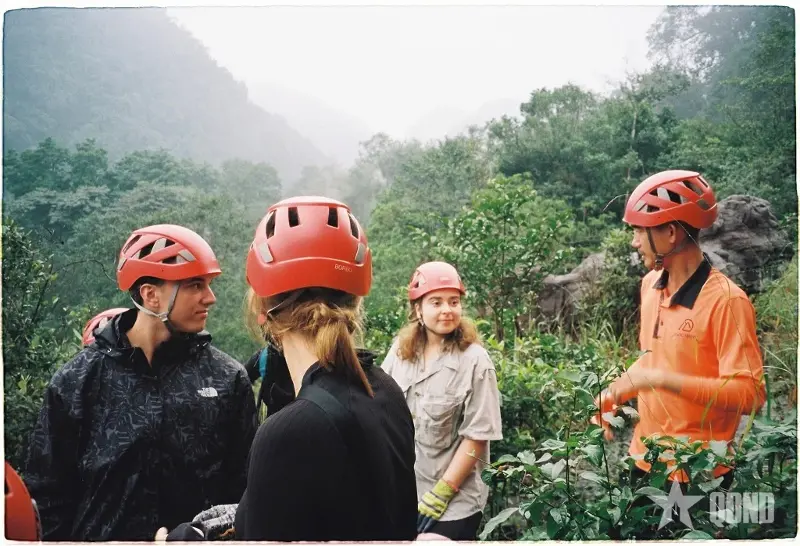 Cave E attracts many foreign visitors.
According to Mr. Do Quang Anh, groups are instructed not to separate, not to touch or break stalactites, not to litter, and to minimize loud noises. During the journey through the forest, guides introduce visitors to the basic characteristics of the local ecosystem and remind everyone not to catch animals or impact the natural environment.
The Survival Valley is vast and diverse, featuring limestone mountains, natural forests, underground streams, caves, and interspersed flat areas. This region is also home to many species of flora and fauna, including rare primates such as the Ha Tinh langur and the Siki gibbon. Therefore, organizing tour routes requires rational exploitation, linking tourism development with the protection of forest resources and the cave system.
Cave E can be explored at various times of the year, but the dry season is generally more favorable due to less slippery forest paths, stable water flow, and high water clarity. During the rainy season, the itinerary depends closely on weather conditions and the safety assessment of the organizing unit.
Leaving Cave E, visitors continue walking under the forest canopy to return to the starting point. A day of trekking through the forest, wading through streams, paddleboarding, and exploring the world beneath the mountain provides not only beautiful photos but also an opportunity to better appreciate the value of nature.
Amidst the development of experiential tourism products, preserving the pristine nature of Cave E and the Survival Valley is of particular importance. Every visitor who adheres to regulations, leaves no litter, and does not impact the landscape contributes to protecting this "crystal palace" in the heart of Phong Nha-Ke Bang National Park.