


Carved from a single block of white and green jade, this incredibly lifelike Chinese cabbage sculpture gleams as if freshly picked from the field, still glistening with morning dew. A grasshopper and a cricket are hidden among the vibrant green leaves, while the anonymous artist has used the material's natural imperfections to create the illusion of veins running along the stem.
Gently placed on a wooden stand, the sculpture, measuring only 2.3 cm in height, is so famous that it has its own dedicated exhibition room. The museum even publishes the dates when the artifact will be "on business"—in other words, when it is loaned out or displayed elsewhere—so that visitors won't be disappointed.
The museum doesn't record specific figures on the number of visitors to the approximately 2 million who come to see the jade cabbage sculpture alone each year. But the long lines of people waiting to take photos suggest that many, if not most, of them come for this reason. "It doesn't look very lifelike in the pictures, but when you see it in person, it's much more fascinating," Chloe Wang, a visitor from mainland China, told CNN during her museum visit.
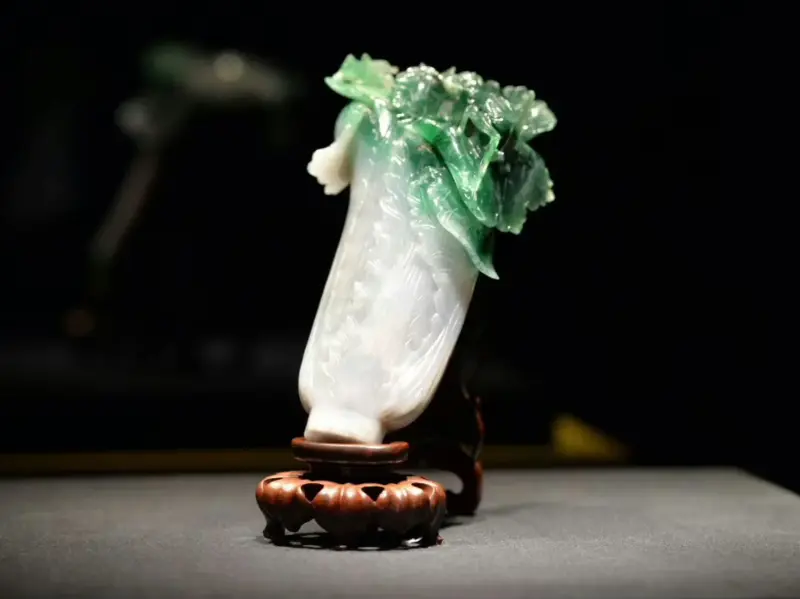
Jade cabbage photographed during an exhibition in Tokyo.
PHOTO: AFP
The jade cabbage, like most artifacts in the collection of the Palace Museum in Taipei, is a royal relic that once resided in the Forbidden City in Beijing before being moved to Taiwan. However, it's not the only one: the Beijing Palace Museum and the Tianjin Museum, also in mainland China, both possess jade cabbage carvings. In fact, the Taiwanese museum itself has two others. So why is this piece, also known as "Jade Cabbage with Insects," so globally famous?
Hsu Ya-hwei, a professor of art history in Taiwan, said the shimmering color of the jade and the sculpting technique helped the work stand out. She said, "The skillful craftsmanship, combined with this unique material, has resulted in a magnificent outcome."
But the enduring popularity of the jade cabbage may also stem from the symbolic meaning it holds. Perhaps part of a dowry a concubine paid to China's Emperor Guangxu in the 1880s, the item has long been associated with purity, fertility, and female prosperity. "The auspicious wishes contained within this item are quite significant, and perhaps the key factor in its appeal to visitors," she added.
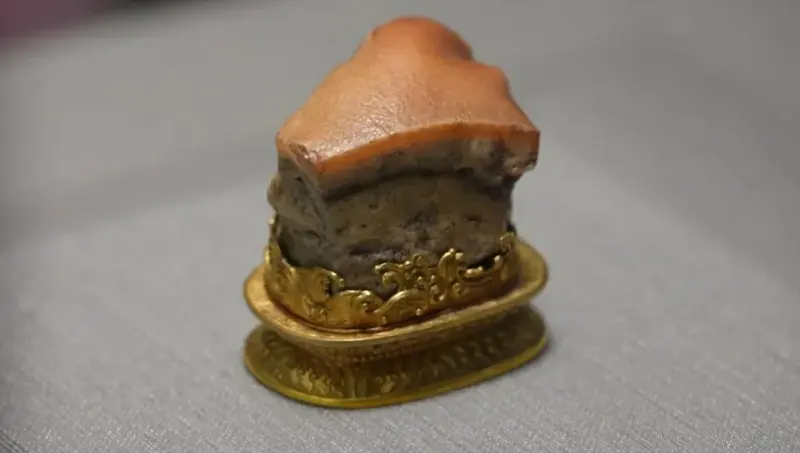
The famous braised pork sculpture.
PHOTO: CNN
After the fall of the Qing Dynasty in 1912, the jade cabbage was discovered in a brightly colored porcelain vase in the Forbidden City. It was later displayed at the Beijing Palace Museum and immediately gained public acclaim upon its unveiling in 1928. In the 1930s, amid fears of the palace collection being lost during wartime, many treasures were evacuated to other cities, spending years en route, sometimes hidden in temples and caves. Eventually, the jade cabbage was brought to Taiwan, where it remains to this day.
The jade cabbage is one of nearly 700,000 artifacts that make up the collection of the Palace Museum in Taipei, which opened at its current location in 1965.
The cabbage is often referred to as one of the museum's "three treasures," along with two other famous artifacts – the meat-shaped stone, a piece of quartz carved to resemble braised pork belly, and the Mao Kung Ting, a traditional cooking utensil bearing the longest known ancient inscription on any Chinese bronze object.