



These two "giants" are expected to crash into each other within the next 100 years, creating a massive gravitational wave explosion capable of shaking spacetime itself.
Astronomers have long regularly observed galaxies colliding and merging, but the final stage of this process has always remained a mystery.
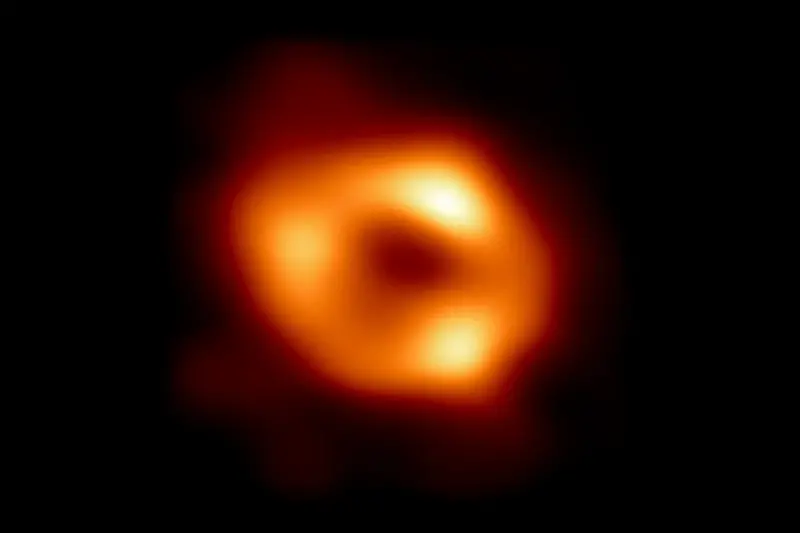
Recently, researchers announced they have found compelling evidence of a pair of supermassive black holes orbiting each other at the center of a distant galaxy.
These two "giants" are expected to crash into each other within the next 100 years, creating a massive gravitational wave explosion capable of shaking spacetime itself.
The new research, accepted for publication in the journal Monthly Notices of the Royal Astronomical Society, focuses on Markarian 501 – a galaxy located approximately 500 million light-years from Earth.
The core of this galaxy is so active that astronomers call it a "blazar."
Here, two black holes, each with a mass equal to 1 billion Suns, appear to be orbiting each other with a period of 121 days.
Commenting on the event, research team leader Silke Britzen from the Max Planck Institute for Radio Astronomy (Germany) said the final collision "will be a truly amazing gravitational wave signal."
During galactic mergers, the central black holes rarely collide head-on immediately.
Instead, they slide past each other and then slowly establish spiral trajectories to move closer together. To look for traces of this phenomenon, Britzen's team analyzed 23 years of data from Markarian 501, collected by the Very Long Baseline Interference Network (VLBA) in the US.
Initially, they observed a beam of high-energy radiation heading toward Earth but saw no movement. However, when they switched to observing at a higher frequency to monitor the region closer to the black hole, they suddenly saw another signal – a second beam directed away from Earth.
"That was unexpected," Britzen shared. The detection of two beams emanating at different angles, combined with a recurring variation in brightness every 121 days, is a crucial clue about the existence and orbital periods of these two black holes.
Nevertheless, since previous candidates for double black holes have remained unconfirmed, independent experts are still being very cautious about this new discovery.
Zoltan Haiman, an astrophysicist at Columbia University, commented: "It's messy, but it looks like two beams, which would require two black holes." He added: "Frankly, it's very complex. … I would say it's still just a candidate."
Scientist Daniel D'Orazio from the Space Telescope Science Institute (USA) also agrees with this assessment: "It's fascinating that this (second beam) seems to behave differently from the other beam... suggesting a different origin." However, he believes that finding a binary black hole system so close to the point of merger seems unbelievable.
He explained: "If this is confirmed to be a dual system, then we are either very lucky, or the population characteristics are not as we expected, implying that there are more such systems."
Fortunately, scientists won't have to wait too long to verify this historic discovery. If the pair of black holes are indeed about to merge, astronomers will be able to measure the shortening of their orbital periods within the next decade.
Furthermore, this system may have been emitting gravitational waves that humans can detect by measuring tiny changes in signals from pulsar networks – stars that rotate at extremely high speeds in the universe. Given these prospects, scientist Britzen optimistically asserts: "There is hope."