



New research reveals how animals in the Amazon rainforest create the 'forest internet,' a communication network that allows them to quickly warn each other of danger.
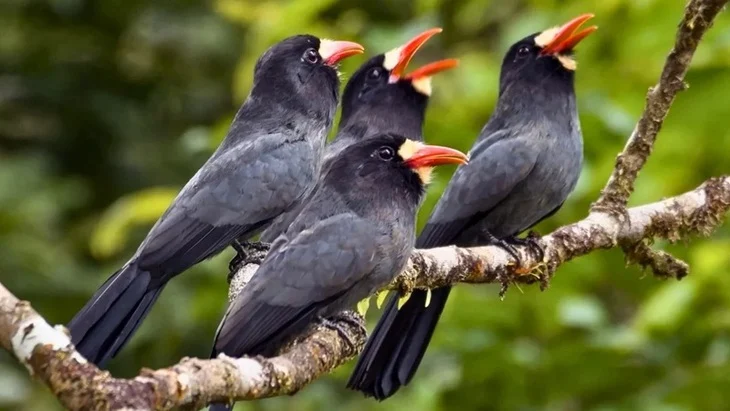
White-fronted nunbirds - Photo: CANVA
Accordingly, when some animals detect a predator, they emit alarm calls, and this signal is quickly "heard" by other species, repeated, and spread throughout the forest canopy.
In a study conducted in the Peruvian Amazon region, the research team used trained birds of prey to trigger warning responses from other birds and primates. They then recorded and played back these sounds to observe how the animal community reacted.
The results show that small birds living in the canopy (canopy), especially those weighing less than 100g, play a central role in signal transmission, according to ScienceAlert on April 21.
Certain bird species, such as the black-fronted and white-fronted nunbird, are particularly notable for their repeated and amplified warning signals.
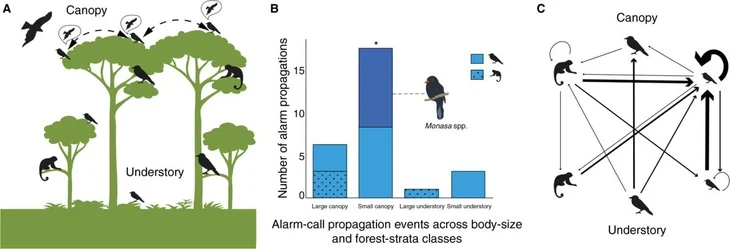
Canopy birds play a crucial role in spreading warning signals - Photo: CURRENT BIOLOGY
Not only birds, but primates such as capuchin monkeys and spider monkeys also participate in this network, reacting to sounds and sometimes continuing to transmit warning messages about danger.
Interestingly, not all signals are widely transmitted. Sounds emanating from the lower layers of the forest are less likely to be received by other species.
However, even without being "transmitted," they still alter the forest's "acoustic landscape." Upon hearing danger signals, smaller birds in the upper canopy almost immediately fall silent, while those in the lower canopy continue to be active.
This finding suggests that the Amazon rainforest's canopy is not only a hub of biodiversity but also functions as an "information network," where animals constantly monitor and respond to each other.
This network complements the concept of the "wood wide web," a system of plant communication through roots and fungi, by demonstrating that animals also have their own "internet" for exchanging information and operating at higher altitudes than the ground.
The research team suggests that changes in sound, particularly sudden silences, could be a sign of threat from predators.
This opens up new avenues of research into how animals communicate and adapt in complex environments, and helps us better understand the intricate interconnectedness within tropical rainforest ecosystems.
The study was published in the journal Current Biology .