



Astronomers at Cornell University have just identified a group of planets with the most ideal environmental conditions for humanity to search for traces of life.
The universe contains billions of celestial bodies, but finding one that truly resembles Earth is an extreme challenge. To date, humans have discovered more than 6,000 exoplanets (planets outside our solar system), but only a very small fraction of them possess characteristics suitable for life.
In a new study published in the monthly journal of the Royal Astronomical Society (MNRAS), a team of experts at the Carl Sagan Institute at Cornell University (USA) selected a list of 45 of the most promising candidates for future observation.
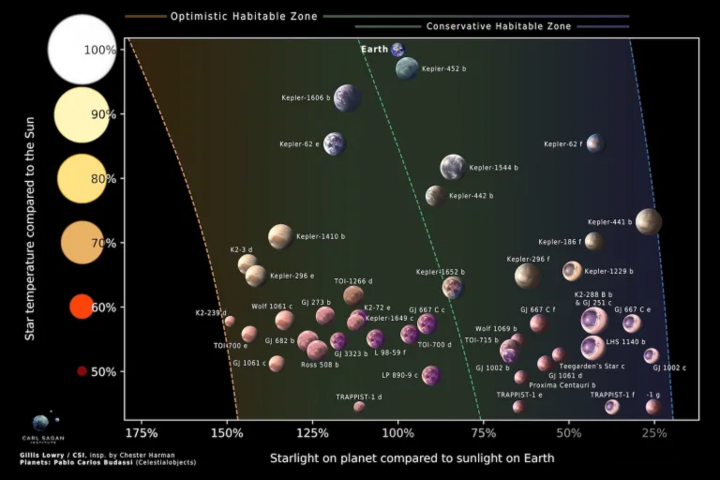
The diagram shows the boundaries of habitable zones around different types of stars. (Source: Gillis Lowry/Pablo Carlos Budassi)
Accordingly, 45 rocky planets have been identified as being located within the "habitable zone" (Goldilocks Zone), the area around a star where there is sufficient distance for liquid water to exist on the surface.
However, if stricter criteria regarding heat and radiation were applied, that number would drop to around 24 truly potential planets.
Leading the list is the planet Proxima Centauri b, located just about 4.2 light-years from Earth. Another notable name is the TRAPPIST-1 planetary system, situated 40 light-years from Earth.
Here, there are up to four planets (designated d, e, f, and g) orbiting a red dwarf at an ideal distance. Theoretically, these are places with rocky surface structures and atmospheres capable of sustaining oceans – a prerequisite for life.
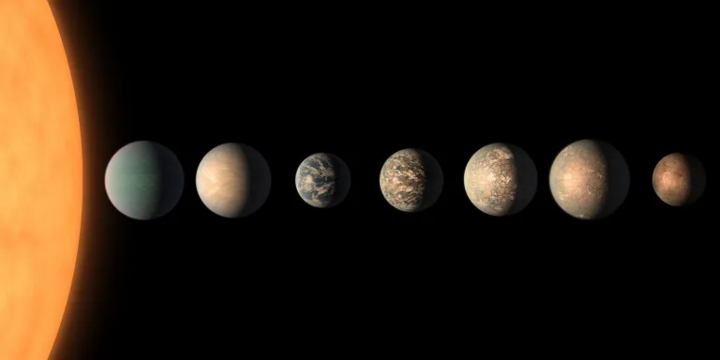
Illustration of the TRAPPIST-1 planetary system with 8 planets a, b, c, d, e, f, g, and h (from left to right) orbiting their host star, of which d, e, f, and g are considered the most Earth-like. (Source: NASA/JPL-Caltech)
Even though the targets have been found, approaching these planets remains a challenging problem with current technological capabilities.
Light takes just over four years to reach Proxima Centauri b, but at the speed of Apollo 10, the fastest spacecraft ever built by humans, it would take us 114,000 years to set foot on this nearest planet.
However, this list serves not only travel ambitions but also acts as a "guide" for super telescopes.
Abigail Bohl, co-author of the study, shared: "We know Earth is habitable, but Venus and Mars are not. By using the Solar System as a reference, we can look for planets that receive energy levels somewhere between what Venus and Mars receive from the Sun."
Concurring with this view, researcher Gillis Lowry emphasized: " While it's difficult to pinpoint exactly where life exists, identifying 'where to look' is a crucial step. These are the best targets for super telescopes like the James Webb or Nancy Grace Roman to focus on observing in the coming years."
Studying the elliptical orbital planets on this list also helps scientists better understand whether sudden temperature changes might hinder the evolution of life.
This is a crucial foundation for humanity to answer the biggest question: "Are we alone in the universe?"