



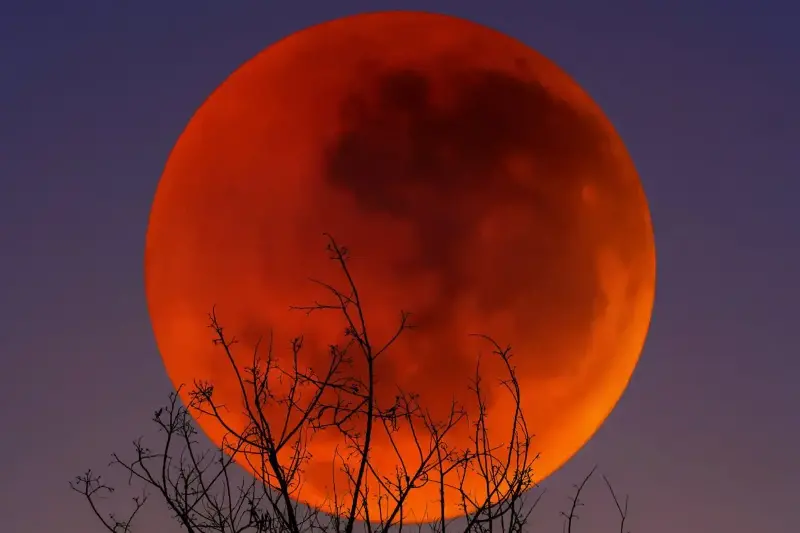
The rare phenomenon of a 'blood moon' visible even after sunrise is intriguing. Will Vietnam have a chance to witness the Selenelion eclipse on March 3rd?
The Selenelion phenomenon occurred in Minneapolis, USA, in October 2014 - Photo: WIKIMEDIA
First, it's important to understand that Selenelion is not an independent phenomenon, but rather a special case that occurs during a total lunar eclipse.
A total lunar eclipse (often called a "blood moon") occurs when the Sun, Earth, and Moon are aligned, with the Earth blocking direct sunlight from reaching the Moon.
At that time, only the red light refracted through the Earth's atmosphere reached the Moon's surface, causing it to turn a deep red.
Selenelion appears in that very context, but in a special geographical location: when a total lunar eclipse occurs precisely at the time the sun is rising or setting at the observation point.
At that moment, thanks to the atmospheric refraction effect which bends the light and makes the celestial object appear higher than its actual position, the observer can see the Sun on one side of the horizon, while the Moon (which is obscured) still appears on the opposite side.
In other words, every Selenelion occurs during a total lunar eclipse, but not every total lunar eclipse will have a Selenelion. The necessary condition is that the viewing location must be precisely on the "dawn or sunset boundary" of the eclipse region.
According to Timeanddate and the lunar eclipse distribution map for March 3rd, this condition only appeared in certain areas such as the East and Southeast coasts of the United States, eastern Canada, parts of Brazil, and eastern South America. These are all places where the total lunar eclipse coincided with sunrise.
In Vietnam, according to Timeanddate, the total lunar eclipse occurred in the evening after the sun had completely set. Vietnam is not located on the edge of the eclipse's dawn zone, so there are no geometric conditions for the sun and moon to appear simultaneously in the sky.
Therefore, Vietnam was unable to observe Selenelion during this event.
It's important to emphasize that not being able to see Selenelion doesn't mean there won't be a lunar eclipse. Vietnam is still within the area for observing the total lunar eclipse, just not in a particularly advantageous position for the rare "simultaneous" eclipse effect to occur.
Anticipating the total lunar eclipse on March 3rd - Photo: NBC NEWS
"Missed opportunity" Selenelion, total lunar eclipse still ongoing.
According to the Hanoi Astronomical Society (HAS), Vietnamese people can observe the total lunar eclipse on the evening of March 3rd. The phenomenon will last 5 hours and 42 minutes, with the total phase lasting 82 minutes when the Moon is completely within the Earth's shadow and turns a brilliant coppery red color.
Specifically, the timeframes (in Vietnam time) are as follows:
- 3:43 PM: Penumbral lunar eclipse begins (not visible in Vietnam).
- 4:50 PM: Partial lunar eclipse begins (not visible in Vietnam).
- 18:03: The total lunar eclipse begins.
- 6:34 PM: Maximum lunar eclipse.
- 7:03 PM: The total lunar eclipse ends.
- 8:18 PM: The partial lunar eclipse ends.
- 9:25 PM: The penumbral lunar eclipse ends.
People can observe the lunar eclipse directly with the naked eye. However, viewing conditions depend on the weather; the sky needs to be clear, without rain or thunderstorms.
Back to the topic
HOANG THI