


Writing in the scientific journal Icarus , a team of authors led by astrophysicist Matthew S. Clement from Johns Hopkins University (USA) re-examined the famous Nice model and the "turbulent period" hypothesis, thereby discovering many new details about giant ice planets.
The Nice model, developed in 2005, is considered the most reliable model of the "dawn" of the solar system.
According to modern versions of this model, the primordial solar system was very chaotic, with giant planets shifting their orbits, interacting gravitationalally strongly, and pushing each other away.
According to this model, the original solar system originally had one or two more ice giant planets like Uranus and Neptune. However, they were flung out of the system by catastrophic interactions in its early stages.
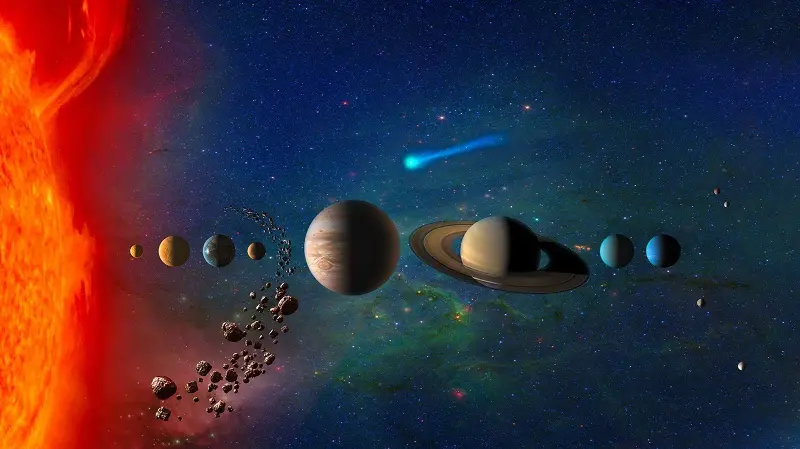
The Solar System may have once had many larger planets - Illustration: NASA
According to Science Alert, this new research examined the Nice model in greater detail, including what happens to Jupiter's and Uranus' moons in the "battle of the giants".
The authors performed computer simulations and found that the probability of survival for the entire moon system around Jupiter and Uranus is less than 15%.
Only one scenario out of 122 simulations showed both the lunar systems of Jupiter and Uranus surviving unharmed.
These two planets originally had many moons. But if Uranus approached another planet at a distance of 0.02 AU (astronomical unit, the distance between Earth and the Sun), or approached gas giants (like Jupiter/Saturn) at a distance of less than 0.1 AU, Uranus's moon system would be destroyed.
Therefore, scientists have proposed three possible explanations for the current state of order in the Solar System.
One possibility is that our world has evolved along a unique, extremely rare, and also extremely fortunate path.
Of these, the two aforementioned large planets completely avoided deep collisions with other giant planets, leaving the primordial moons safe and sound.
Secondly, the lunar system of Uranus could be a product of rebirth, a finding supported by some previous research.
Thirdly, the Nice model may not be complete.
Regardless of which scenario is chosen, the research demonstrates that the story of evolution from a chaotic region 4 billion years ago to a precisely functioning solar system today remains a major mystery requiring further investigation, and is not as simple as older models have assumed.