



Dunhuang – a legendary crossroads on the Silk Road – is not just a place to visit, but to experience deeply. Today, traveling to Dunhuang, China, is not simply a trip, but a journey back in time, where every step touches upon layers of vibrant historical sediment.
Nestled on the edge of the harsh Gobi Desert,
Dunhuang impresses not only with its magnificent landscapes but also with its layers of cultural heritage spanning thousands of years. It was once a stopover for caravans traversing Asia and Europe, a meeting place of ancient religion, art, and commerce.
Unlike familiar destinations, Dunhuang offers a very different feeling – both remote, mysterious, and captivating. This isn't just a trip to check in, but a journey to:
Unlike familiar destinations, Dunhuang offers a very different feeling – both remote, mysterious, and captivating. This isn't just a trip to check in, but a journey to:
- Experience history
- Experience a different kind of space.
- And temporarily escape from the hustle and bustle of modern life.
1. Dunhuang, China – A destination worth visiting once in a lifetime.
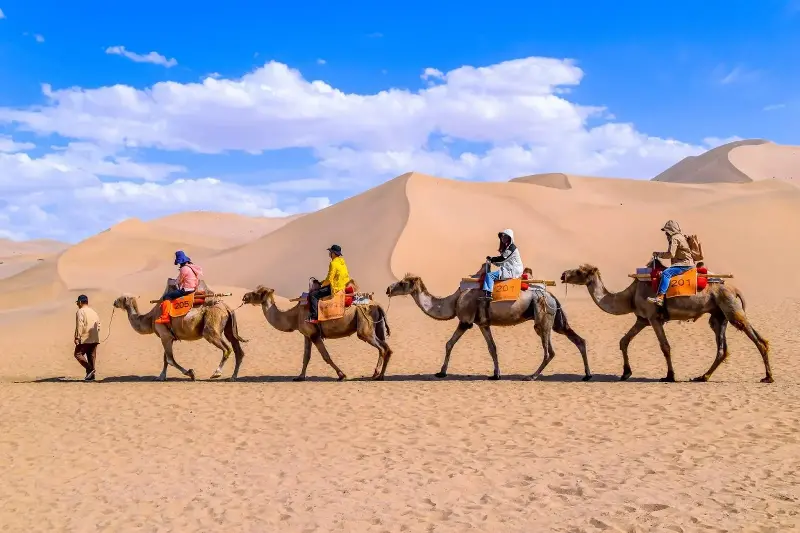
Dunhuang is an oasis located in northwestern China , in Gansu Province, at the intersection of the Gobi Desert and the eastern edge of the Taklamakan Desert. This unique location made it the most important gateway of the ancient Silk Road.
For thousands of years, merchants, missionaries, artisans, and travelers from Persia, India, Central Asia, and Europe have passed through this area. They brought with them not only goods, but also beliefs, art, and knowledge. Therefore, Dunhuang is not just a tourist destination – it is also considered a "living museum" of human civilization.
Beyond its historical value, this place also offers unique experiences:
- The desert landscape is majestic and completely different from familiar destinations.
- The Silk Road heritage bears the strong imprint of the East-West cultural exchange.
- Buddhist cave systems with world-class artistic value.
- These journeys are about exploration , not just sightseeing.
(*) The Silk Road is a network of ancient trade routes connecting East and West. This special route is also a place of cultural exchange, craftsmanship, art, etc., between ancient and modern civilizations. In trade, the most valuable commodity along the main route was silk. This clearly explains the name Silk Road. Dunhuang occupies a strategic position at the crossroads of the ancient Southern Silk Road and the main route leading from India through Lhasa to Mongolia and Southern Siberia, as well as controlling the entrance to the narrow Hexi Corridor, leading directly to the center of the northern Chinese plains and the ancient capitals of Chang'an (now known as Xi'an) and Luoyang.
2. What is the best time of year to visit Dunhuang?
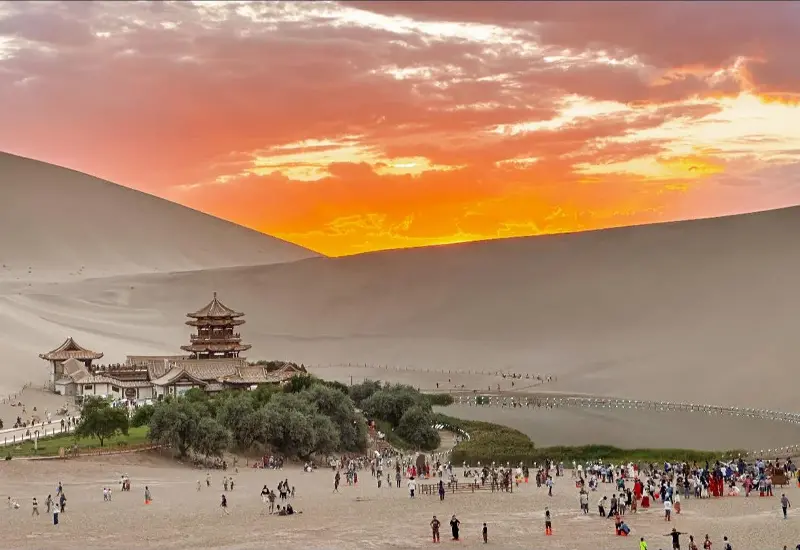
Dunhuang has a typical desert climate: dry, with little rainfall and large temperature fluctuations.
The best time to visit Dunhuang, China:
- May – June: The weather is pleasant, the sky is clear and vast, and the natural scenery is at its most beautiful.
- September – October: The most beautiful autumn of the year – the entire Dunhuang landscape is bathed in golden sunlight and colorful leaves. Plus, it's a chance to enjoy freshly harvested, incredibly delicious local fruits like watermelon, apricots, and grapes…
3. Travel tips for Dunhuang - A journey that opens the door to "another world"
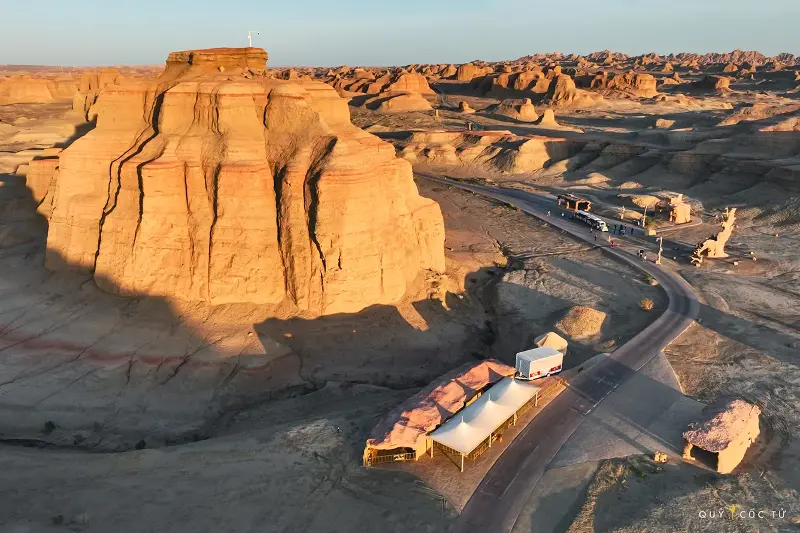
Unlike popular tourist cities, a trip to Dunhuang offers a unique experience – as if you're gradually leaving behind the hustle and bustle of modern life to step into a completely different space, where only wind, sand, and traces of history remain.
Despite being a relatively small city, Dunhuang has a fairly convenient transportation system. Depending on your schedule and desired experience, you can choose from the following options to get to Dunhuang:
Plane
Dunhuang boasts Mogao International Airport, located approximately 12km from the city center. From here, there are flights connecting to many major cities such as Beijing, Shanghai, Xi'an, Chengdu, and Lanzhou.However, during the winter months, due to harsh weather conditions, flight frequencies may decrease, so you should carefully check the schedule before making your plans.
Train
This is a popular mode of transportation and also offers many interesting experiences. Dunhuang has two main stations: Dunhuang Station and Liuyuan Station.- Dunhuang Railway Station is located near the city center (about 10km).
- Liuyuan Station is about a 2-hour drive from the city center.
Long-distance buses
From neighboring provinces such as Gansu, Qinghai, and Xinjiang, you can also reach Dunhuang by long-distance bus. This is a suitable option if you are combining your trip with exploring multiple points along the Silk Road.City transportation & sightseeing
Tourist attractions in Dunhuang are often far apart and scattered across the desert, so getting around isn't as simple as in larger cities. You can:- Take a taxi
- Rent a private car
- Or join pre-designed itineraries.
Book your China tour now:
4. Must-see destinations and experiences when traveling to Dunhuang
4.1. Crescent Moon Stream – “The Blue Moon” in the heart of the Gobi Desert
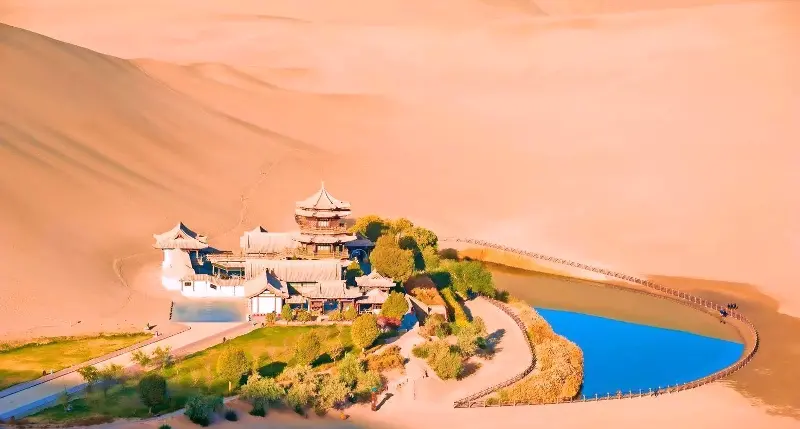
Mingsha Mountain and Crescent Moon Spring (Mingsha Mountain - Crescent Moon Spring) is a famous scenic spot in Dunhuang, a "heritage city" in Gansu Province, China. It was once a stopover point for merchants and travelers on the Silk Road connecting China with Central and West Asia.
Amidst the vast sands of the Gobi Desert, Crescent Moon Spring emerges as a marvel. This small lake, shaped like a crescent moon, has existed for over 2000 years without ever being swallowed by the desert. The crystal-clear water contrasts sharply with the golden sand, creating a surreal yet tranquil scene.
Standing atop the sand dune, looking down at the "moon" in the middle of the desert, you'll understand why this place was once an indispensable stop for ancient caravans.
Beside the lake is an ancient temple, a row of shady green trees, and souvenir shops. One of the most memorable experiences here is riding a camel, slowly making its way through the sand dunes – recreating the journey on the legendary Silk Road.
4.2. Jade Gate Pass – A gateway to history on the legendary Silk Road
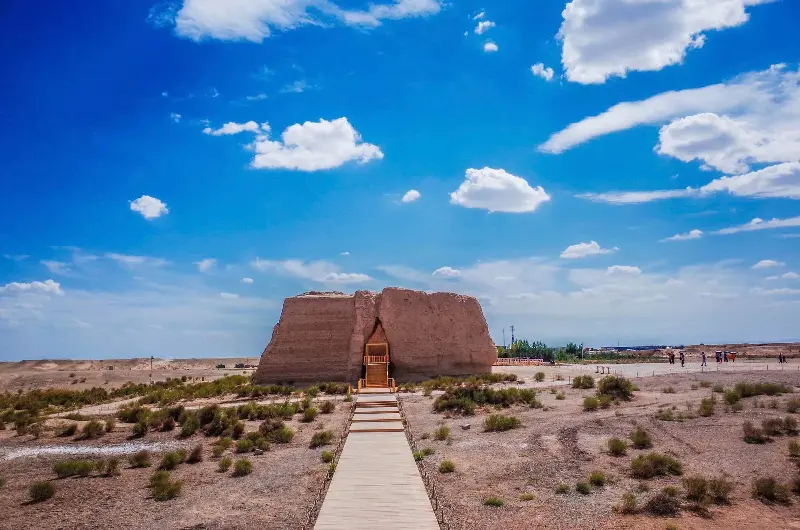
Jade Gate Pass was once the last gateway between the Central Plains and the Western Regions. Passing through this pass, caravans would enter a completely different world – wild, harsh, yet full of mystery. An ancient saying, "The spring breeze cannot cross Jade Gate Pass," describes the scene of the ancient battlefield; therefore, visiting here will surely make you feel as if you are reliving a prosperous ancient era.
Today, the remaining ruins of the Jade Gate Pass evoke a feeling of both solitude and grandeur. Desert winds blow through the ancient walls, as if recounting stories from thousands of years ago. This is not just a tourist attraction, but a place where you can truly "feel" history.
4.3. Danxia Geomorphology – A Masterpiece of Nature
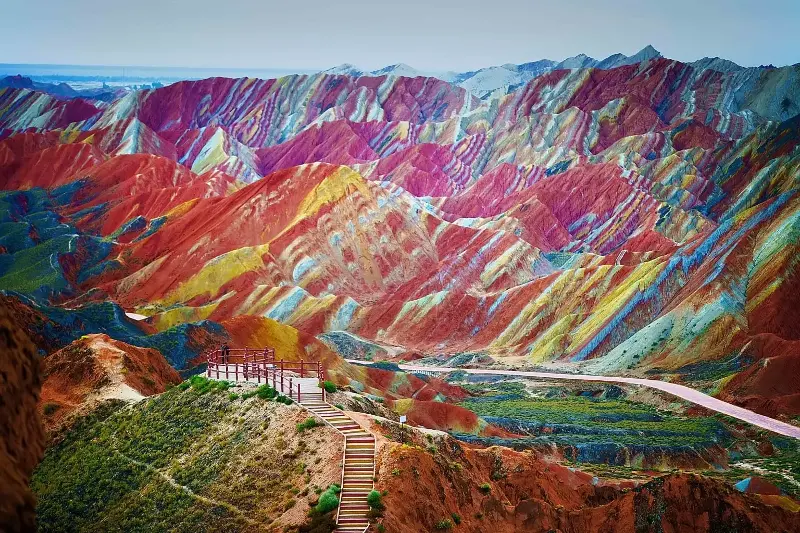
Located in Gansu Province, northwestern China, Zhangye Geopark, with its striking and unique Danxia landforms, was recognized as a UNESCO World Geopark in 2020. Unlike any other landscape, Danxia impresses with its multicolored mountain ranges – red, orange, and yellow interspersed like a giant painting.
Formed over millions of years of weathering, this place is a testament to the power of nature. At different times of the day, the changing light causes the landscape to constantly transform, creating spectacular scenes.
With its unique features, this place has been voted one of the "7 most beautiful Danxia geomorphological areas in China", one of the "6 most beautiful and bizarre geomorphological areas in China", one of the "10 geographical wonders of the world", and one of the "22 most memorable destinations in the world"... This is one of the destinations that surprises many tourists the most when traveling to Dunhuang, China.
4.4. Mogao Caves - the world-famous "Cave of a Thousand Buddhas"
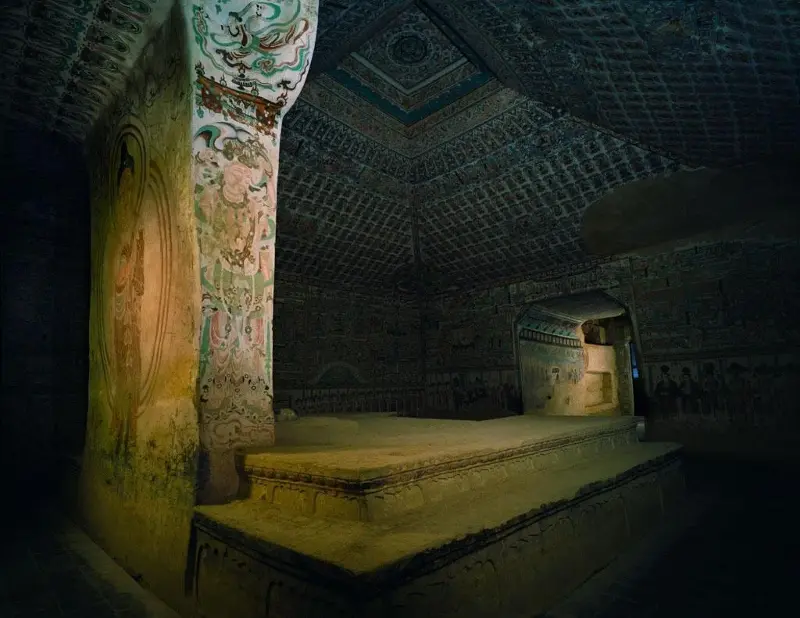
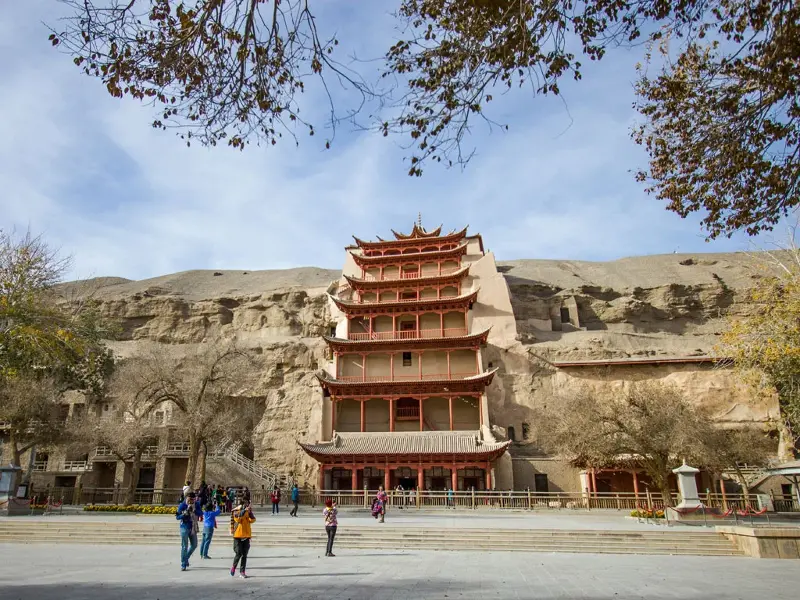
The Mogao Caves, also known as the "Cave of a Thousand Buddhas," are one of the largest and most important Buddhist cave complexes in the world.
With nearly 500 caves, this place houses thousands of murals and Buddha statues dating back over 1000 years. Every detail reflects the cultural exchange between East and West.
Entering the Mogao Caves is not just sightseeing, but an almost sacred experience – where you can feel the depth of history, art, and faith. This will certainly be a paradise for Buddhist followers during their Dunhuang trip.
Book your tour now:
5. Dunhuang Cuisine – A Mark of Cultural Intermingling
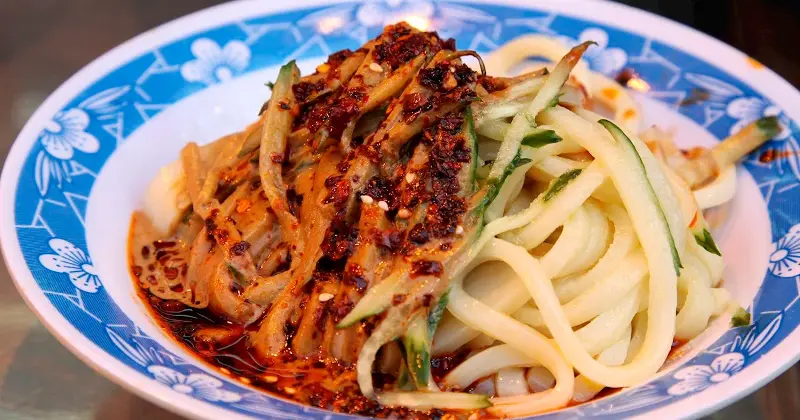
Dunhuang cuisine is a unique blend of Chinese style and Central Asian influences, resulting in very distinctive flavors.
- Yellow noodles with donkey meat
- Niang Pi Zi (cold noodles)
- Lamb soup
- Apricot and dried fruit tea
The cuisine here isn't overly elaborate, but it's precisely its simplicity and uniqueness that makes the experience even more memorable.
6. Things to note when traveling to Dunhuang, China
To make your trip more enjoyable, please keep the following points in mind:
- Chinese Visa: Vietnamese tourists need to apply for a visa before entering China. You should prepare your documents early to avoid disrupting your plans.
- Weather & Clothing: Sunny during the day, can be cold at night. Bring sunglasses, a sand-proof scarf, and sunscreen.
- Booking tickets: Some attractions, such as the Mogao Caves, have limited daily visitor numbers, so it's advisable to book in advance to secure your schedule.
- Plan your trip: Since the attractions are far apart, planning your itinerary in advance will save time and optimize your experience.
>> Check out our tour now:
1. China: The Silk Road's Legacy - Tay Ninh - Qinghai Lake - Jiayuguan - Danxia Landform - Poplar Forest - Dunhuang - Lanzhou
2. China & Kazakhstan: Xinjiang Silk Road - Tiemen Pass - Sayram Lake - Turpan - Flaming Mountains - Kazakhstan - Burabay National Park - Almaty - Charyn Gorge - Xi'an - Terracotta Army | New Program
3. Xinjiang - A Trace of the Silk Road (Summer)
There are places you can visit anytime. But there are also journeys that, if you don't go, you'll always feel like something is missing. Dunhuang is one of those places.
In the vast desert, where every step is intertwined with millennia of history, you'll realize that some experiences are irreplaceable. And perhaps the greatest regret isn't the distance of the journey, but that you didn't start it sooner.
If Dunhuang, China, has made you want to see the legendary Silk Road firsthand, check out the right itinerary and start planning your trip today.
But
For more information about the program, please contact:
VIETRAVEL
190 Pasteur Street, Xuan Hoa Ward, Ho Chi Minh City
Tel: (028) 3822 8898 - Hotline: 1800 646 888
Fanpage: https://www.facebook.com/vietravel
Website: www.travel.com.vn
Source of the article: Compiled and collected from various sources.
@travelguide #travelguide
_CN_