



Walking doesn't make muscles as noticeably bigger as weight training, but it still helps increase strength, improve lean muscle mass, and cardiovascular health. Adjusting your walking technique correctly can optimize the effectiveness of exercise.
Walking is a simple, easy form of exercise suitable for most people. However, many people wonder whether walking can help build muscle. Physiologically, walking is not the optimal exercise for building large muscle mass (hypertrophy) like weightlifting or high-intensity resistance training. Nevertheless, walking can still:
- 1. Why does walking still help strengthen muscles?
- 2. Muscle groups used when walking
- 3. Walking techniques to strengthen muscles
- 4. Combine walking with resistance training for effective muscle growth.
- 5. Exercises to help build leg muscles
- 6. Muscle building mechanisms: The role of resistance training and nutrition
- 7. Does walking help reduce fat and improve body shape?
- 8. The overall benefits of walking
- Stimulates muscle activity.
- Improve muscle strength.
- Slight increase in lean muscle mass.
- Helps to tone muscles…
In particular, for those who are sedentary or just starting to exercise, regular walking can produce a noticeable improvement in lower body strength.
1. Why does walking still help strengthen muscles?
When walking, the body has to mobilize many muscle groups working together to move and maintain balance. Although the intensity is not high, if done regularly, the muscles will adapt and become stronger.
This mechanism involves:
- Increases the ability to mobilize muscle fibers.
- Improve blood circulation to the muscles.
- Increase muscle endurance...
However, because it doesn't create enough significant mechanical stress, walking is unlikely to cause the micro-injuries to muscles—a factor necessary to stimulate strong muscle growth like resistance training does.
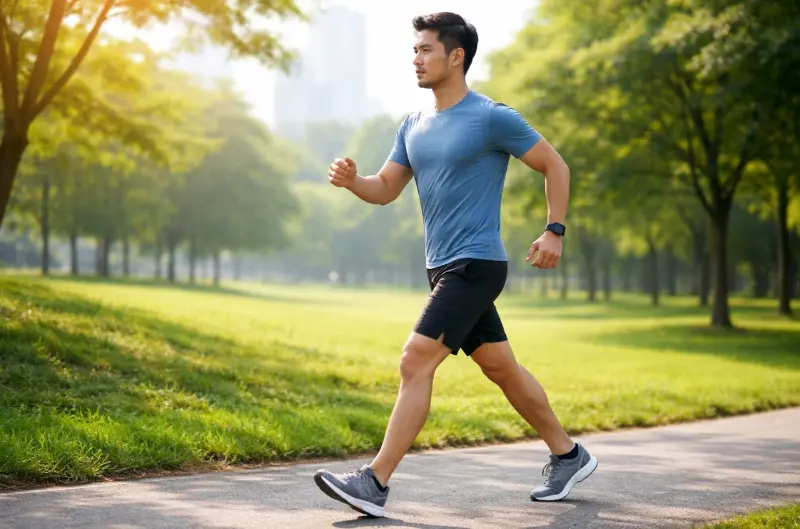
Walking can stimulate muscle growth, strength, and lean muscle mass…
2. Muscle groups used when walking
Walking primarily engages muscle groups in the lower limbs and a portion of the upper body.
- Calf muscles and soleus muscles: Help propel the body forward.
- Gluteal muscles: Maintain pelvic stability and support leg movement.
- Hamstring muscles: Help to bend the knee and pull the leg backward.
- Quadriceps muscle: Helps extend the knee when walking.
- anterior tibial muscle: Lifts the foot, prevents falls...
Additionally, when walking briskly or using walking sticks, upper body muscles such as those in the shoulders and arms are also activated to a certain extent.
3. Walking techniques to strengthen muscles
To optimize muscle development while walking, it's necessary to gradually increase intensity and vary your training methods.
Some effective methods include:
1. Increase your walking speed: Walking faster increases your heart rate and engages more muscle fibers than walking slowly, thereby improving muscle strength and endurance.
2. Walking uphill or climbing stairs: Uphill terrain increases the load on the thigh, gluteal, and calf muscles, causing these muscle groups to work harder.
3. Add extra weight: You can use a weighted vest or a weighted backpack to increase pressure on your muscles. Weighted vests are generally recommended because they distribute the weight evenly.
4. Avoid holding onto the handrails on the treadmill: Letting your hands down allows your body to support its own weight, increasing the effectiveness of leg muscle activity and improving balance.
5. Use walking sticks: Walking sticks help activate additional arm, shoulder, and back muscles, making them suitable for those who want a full-body workout.
6. Change direction and terrain: Walking on different terrains or walking backward (with control) engages more muscle groups, especially the quadriceps.
7. Interval training: Alternating between brisk walking and slow walking, or walking and light jogging, helps increase exercise intensity and supports improved muscle strength.
4. Combine walking with resistance training for effective muscle growth.
To build muscle noticeably, combine walking with resistance exercises. A suitable form of exercise is circuit training:
- 5-minute walk
- Perform 10 squats.
- 5-minute walk
- Perform 10 lunges.
- 5-minute walk
- Perform full-body exercises such as jumping jacks...
Repeating this cycle helps to both increase cardiovascular endurance and stimulate muscle growth.
5. Exercises to help build leg muscles
To maximize the effectiveness of walking, you can supplement it with simple exercises:
- Knee raises in place improve thigh muscle strength.
- Standing on your tiptoes strengthens your calf muscles.
- Squats without weights develop the gluteal and thigh muscles...
Each exercise should be performed 10–15 times, with 2–3 sets depending on your ability.
6. Muscle building mechanisms: The role of resistance training and nutrition
For muscles to grow in size (hypertrophy), two main factors are necessary:
1. Mechanical stimulation from training : Resistance exercises such as weightlifting create micro-injuries in muscle fibers. During recovery, the muscles will grow larger and stronger.
2. Ensure adequate protein intake: Protein is essential for muscle repair and building. Without sufficient protein, the body cannot recover effectively after exercise.
General recommendation:
- Maintain a minimum protein intake of approximately 0.8 g/kg of body weight/day.
- If you want to build muscle: approximately 1.2–1.6 g/kg/day depending on your activity level.
7. Does walking help reduce fat and improve body shape?
Although walking doesn't help build muscle mass, it plays an important role in weight management and fat loss.
- Increased energy consumption.
- Improves metabolism.
- Helps maintain lean muscle mass...
When walking is combined with a proper diet and resistance training, the body can significantly improve its muscle-to-fat ratio.
8. The overall benefits of walking
In addition to strengthening muscles, walking offers many other health benefits:
- Improve cardiovascular health.
- Helps control blood pressure.
- Stabilize blood sugar levels.
- Lower bad cholesterol.
- Improves balance.
- Improve your mood...
This is why walking is encouraged as a foundational activity in community health care.
Walking isn't the most effective way to build massive muscle, but it still plays a crucial role in improving muscle strength, maintaining lean muscle mass, and enhancing overall health. To achieve noticeable muscle gain, you need:
- Increase walking intensity (speed, incline, weight)
- Combine resistance training exercises.
- Ensure you get enough protein...
Walking, when done correctly, remains a crucial foundation for maintaining fitness and preventing many chronic diseases.
Readers are invited to read more: