



Scientists have just discovered that horses are capable of producing two different sounds simultaneously, one high-pitched and one low-pitched, turning each neigh into a message with two layers of meaning.
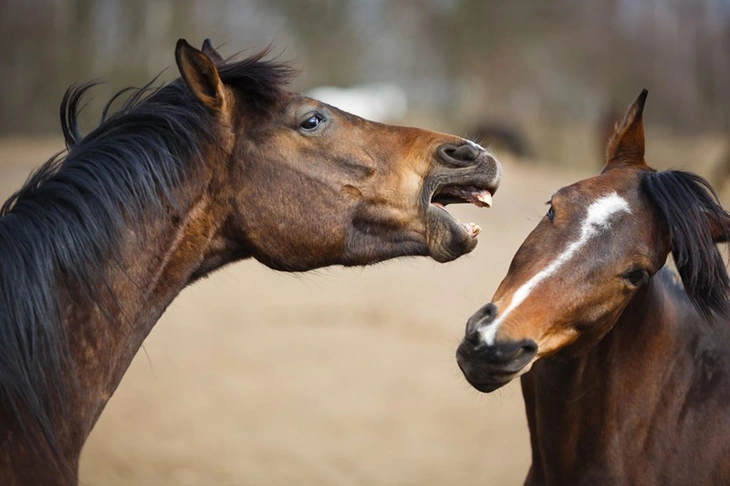
The neighing of a horse is a message with two layers of meaning - Photo: CASTENOID 123RF
Horses are large animals, so as a general rule, they usually produce low-pitched sounds. However, a horse's neigh contains surprisingly high frequencies.
To explain this phenomenon, scientists analyzed the structure of the larynx, veterinary data, and the acoustic characteristics of the neighing sound.
The results show that each horse neigh is actually a two-layered message, combining both low and high pitches simultaneously, and is a rare vocal mechanism in mammals, according to SciTechDaily .
Accordingly, horses produce low notes by vibrating their vocal cords, similar to how humans sing. At the same time, they produce high notes by "whistling" through their larynx, as the airflow creates turbulence inside.
This is a rare acoustic phenomenon called "biphonation," which means a sound contains two different fundamental frequencies, one high and one low.
"We have now identified exactly how the two frequencies in a horse's neigh are produced," said Elodie Briefer, the study's lead author and a researcher at the University of Copenhagen (Denmark).
Previous studies have shown that these two frequencies carry different information about the emotional state of horses, but the mechanism of vocalization remains unclear.
According to new research, the high-pitched sound is produced by "laryngeal whistling," similar to how humans whistle with their lips, but it takes place entirely inside the horse's larynx.
Previously, this phenomenon was only observed in small rodents such as mice. Horses are the first large mammals discovered to use this mechanism, and also the only ones capable of combining laryngeal whistling with vocal cord vibration in the same sound.
To verify this, the research team conducted experiments on the larynx of deceased horses, passing air and then helium gas through it. Because sound travels faster in helium, the frequency of the whistle was higher when using helium, while the sound produced by the vibration of the vocal cords remained unchanged.
The results showed that only the high-pitched part changed, confirming the two independent vocalization mechanisms.
Scientists believe that the ability to speak in two voices allows horses to convey multiple pieces of information simultaneously, such as expressing emotions and transmitting social signals at the same time.
This discovery helps shed light on the diversity and complexity of vocal communication in mammals, even though horses have lived in close proximity to humans for over 4,000 years.
The study was published on February 23 in the journal Current Biology .