


If all goes according to plan, NASA will carry out its first crewed lunar landing mission since 1972 in early 2028 as part of the Artemis program.
Besides the challenge of returning humans to the Moon, the vehicles that will travel on its surface also play a crucial role. They will not only support exploration but also assist in building a permanent base on the Moon – which NASA hopes will become humanity's first outpost on another planet .
At the Moon Base event held at NASA headquarters in Washington, D.C., in late May, the agency announced new contracts for manned Lunar Terrain Vehicles (LTVs) and unmanned cargo ships destined for the Moon.
NASA has selected two companies for the final round of its LTV development program: Astrolab and Lunar Outpost. These two companies received contracts worth $219 million and $220 million, respectively, to develop the first phase of the lunar rover.
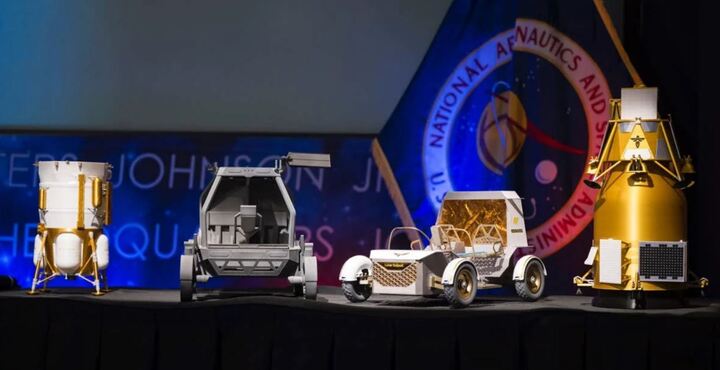
The Lunar Outpost's Pegasus (right) and Astrolab's CLV-1 (left) have quite similar designs, both inspired by side-by-side off-road vehicles. Each vehicle weighs about one ton and is designed to carry two astronauts.
In terms of operational capabilities, Pegasus has a top speed of approximately 9.6 km/h, while CLV-1 reaches nearly 14.5 km/h on the flat terrain of the Moon. Both can overcome inclines of up to 20 degrees.
Both models utilize a purely electric powertrain. They can be controlled directly by astronauts, operated remotely from Earth, or autonomously maneuvered during specific missions.
CLV-1 is developed based on Astrolab's FLEX platform. The vehicle is capable of carrying people, transporting cargo, and supporting remote-controlled missions. A notable advantage is its ability to fold compactly for transport, saving space on launch vehicles.
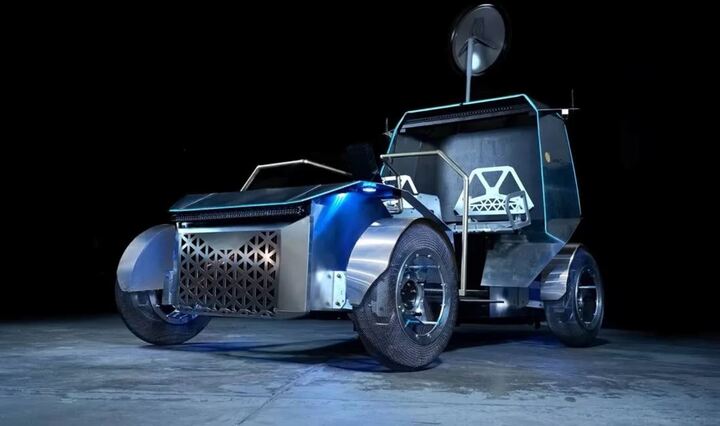
Lunar Outpost's vehicle model.
Meanwhile, Pegasus is a development of the Lunar Outpost Eagle model to meet NASA's new requirements for manned all-terrain vehicles. The vehicle incorporates many technologies inherited from the Apollo program and uses a battery pack developed by GM. According to the company, Pegasus can achieve a range of up to approximately 900 km.
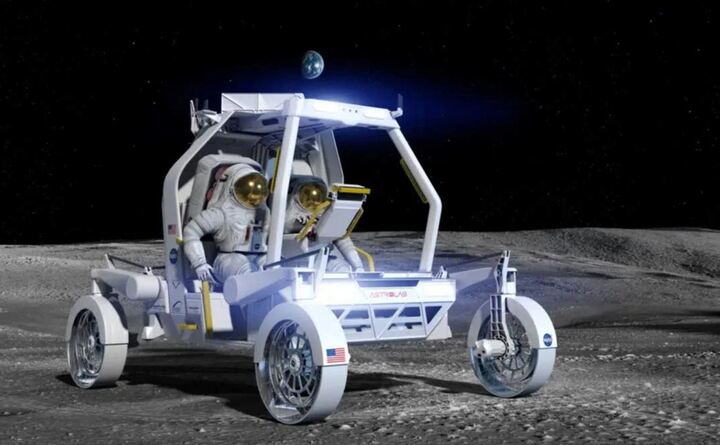
This is a model from Venturi Astrolab.
Despite possessing advanced technology, both vehicles still had to prove their durability in the extremely harsh environment of the Moon. The surface of this celestial body is covered with sharp, highly abrasive dust, which the Apollo astronauts described as resembling finely ground glass powder.
Furthermore, the large temperature difference between day and night, along with the lack of a protective atmosphere, means that all equipment operating on the Moon must meet exceptionally stringent durability standards.
In an environment where even a minor technical error can have serious consequences, Astrolab and Lunar Outpost will have to optimize every aspect to create the most reliable vehicles for future Artemis missions.