



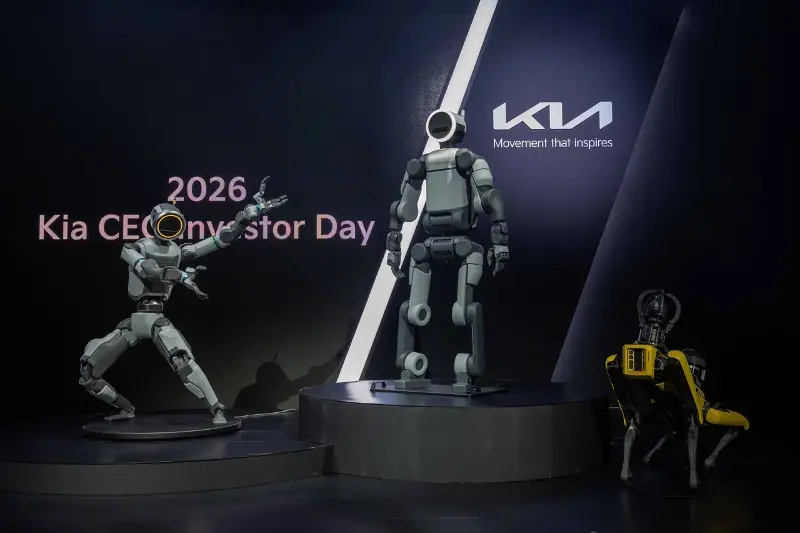
Kia Corporation has announced its mid- to long-term business strategy and financial targets at its 2026 CEO Investor Day, outlining plans to expand global sales, accelerate electrification, and advance future mobility technologies through 2030.
The company is targeting global annual sales of 4.13 million units by 2030, equivalent to a 4.5% market share. This compares with a 2026 target of 3.35 million units and a 3.8% share. President and CEO Ho Sung Song said electric vehicles, hybrids, autonomous driving, and robotics will be key drivers of growth.
Kia plans to expand its electrified and combustion lineup across multiple segments. By 2030, the company aims to sell 1 million electric vehicles annually, supported by 14 EV models. Hybrid sales are projected to reach 1.1 million units with a lineup of 13 models, while nine new internal combustion engine models are also planned. In the commercial space, Kia targets 232,000 annual sales of Platform Beyond Vehicle (PBV) models, including the PV5, PV7, and PV9. A body-on-frame pickup with hybrid and extended-range electric variants is also planned by the end of the decade.
Read more: Kia introduces the next-generation Seltos
The EV strategy focuses on expanding the product range, improving accessibility, and strengthening the supply chain. Kia will increase its EV lineup from 11 models in 2026 to 14 by 2030, covering passenger vehicles, SUVs, and PBVs. The company is developing a next-generation EV platform to improve battery capacity, motor performance, and energy density. Charging infrastructure will also be expanded through global partnerships, with access to around 240,000 chargers in North America, 1 million in Europe, and 480,000 in Korea. Production will be localized across key regions, including Korea, Europe, the United States, and India.
Kia is also expanding its PBV business to address demand in the light commercial vehicle market. The PV5, first launched in 2025, is being rolled out globally, with additional models planned in the coming years. The PV7 is scheduled for 2027, followed by the PV9 in 2029. The company plans to offer more than 40 body configurations and to provide integrated business solutions, including fleet management systems, financing, and maintenance services.
Regionally, Kia aims to grow sales across major markets. In the United States, the company targets 1.02 million units annually and a 6.2% market share by 2030, supported by an expanded hybrid lineup, a full SUV range, and entry into the pickup segment. In Europe, Kia aims to sell 746,000 units and capture 4.8% market share, with electric vehicles accounting for 66% of total sales. In emerging markets, including India, the company targets 1.48 million units and a 6.6% market share. India alone is expected to contribute 410,000 units annually, supported by an expanded model lineup and dealer network.
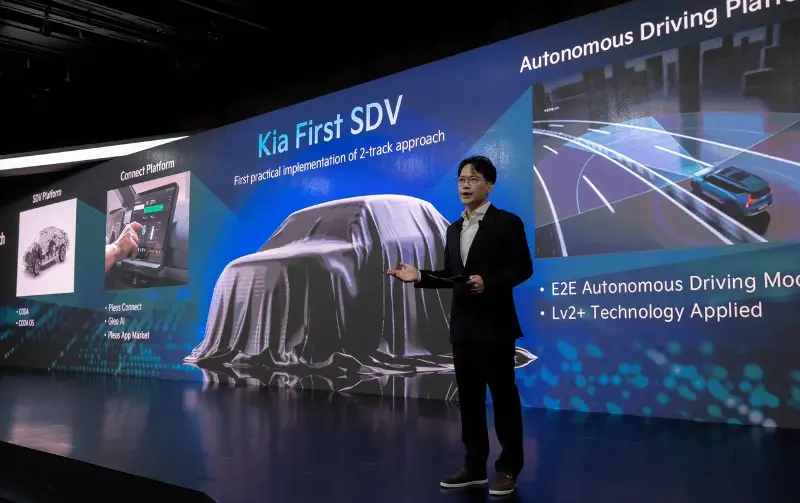
Kia also outlined its plans for autonomous driving and software-defined vehicles. The company aims to complete development of its first SDV by 2027, initially featuring Level 2+ highway autonomous driving. This will be followed by Level 2 and above capabilities for urban environments starting in 2029. The development is supported by partnerships, including with NVIDIA, and focuses on building data-driven systems through large-scale real-world driving data.
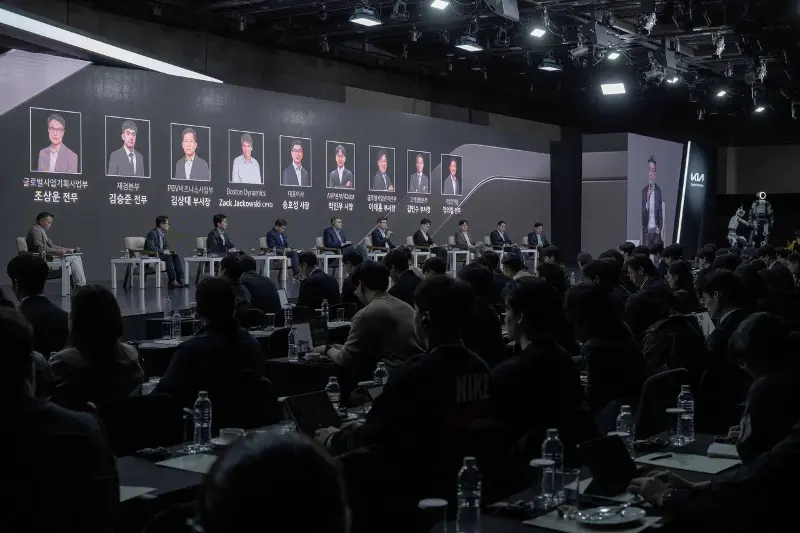
In robotics, Kia and Hyundai Motor Group are working with Boston Dynamics to deploy advanced robots in manufacturing and logistics. The Atlas robot is scheduled for deployment at Hyundai Motor Group Metaplant America in 2028, with expansion to Kia AutoLand Georgia and other facilities in 2029. Robotics will also support last-mile delivery solutions integrated with PBVs.
Kia plans to invest KRW 49 trillion between 2026 and 2030, including KRW 21 trillion allocated to future businesses such as electrification, autonomous driving, and robotics. By 2030, the company aims to achieve revenue of KRW 170 trillion, operating profit of KRW 17 trillion, and an operating margin of 10%.
For 2026, Kia targets 3.35 million vehicle sales, revenue of KRW 122.3 trillion, and operating profit of KRW 10.2 trillion. The company is also aiming for a total shareholder return of more than 35% between 2026 and 2028. Kia said it will continue to adapt its strategy to market conditions while expanding its electrified lineup and investing in future mobility technologies.
So what do you think? It does seem very ambitious, both short- and long-term, for Kia, but the brand has been producing a quality lineup for some time now.
The post Kia has big plans ahead – Targets 4.13 million unit sales by 2030 appeared first on YugaAuto: Automotive News & Reviews in the Philippines.